

“You know nothing, Jon Snow.”
~Ygritte, Game of Thrones
Tanning is a complex equation involving physics, biology, and a lot of common misconceptions. Here is how your environment and habits can crank your UV exposure up or down without asking your permission.
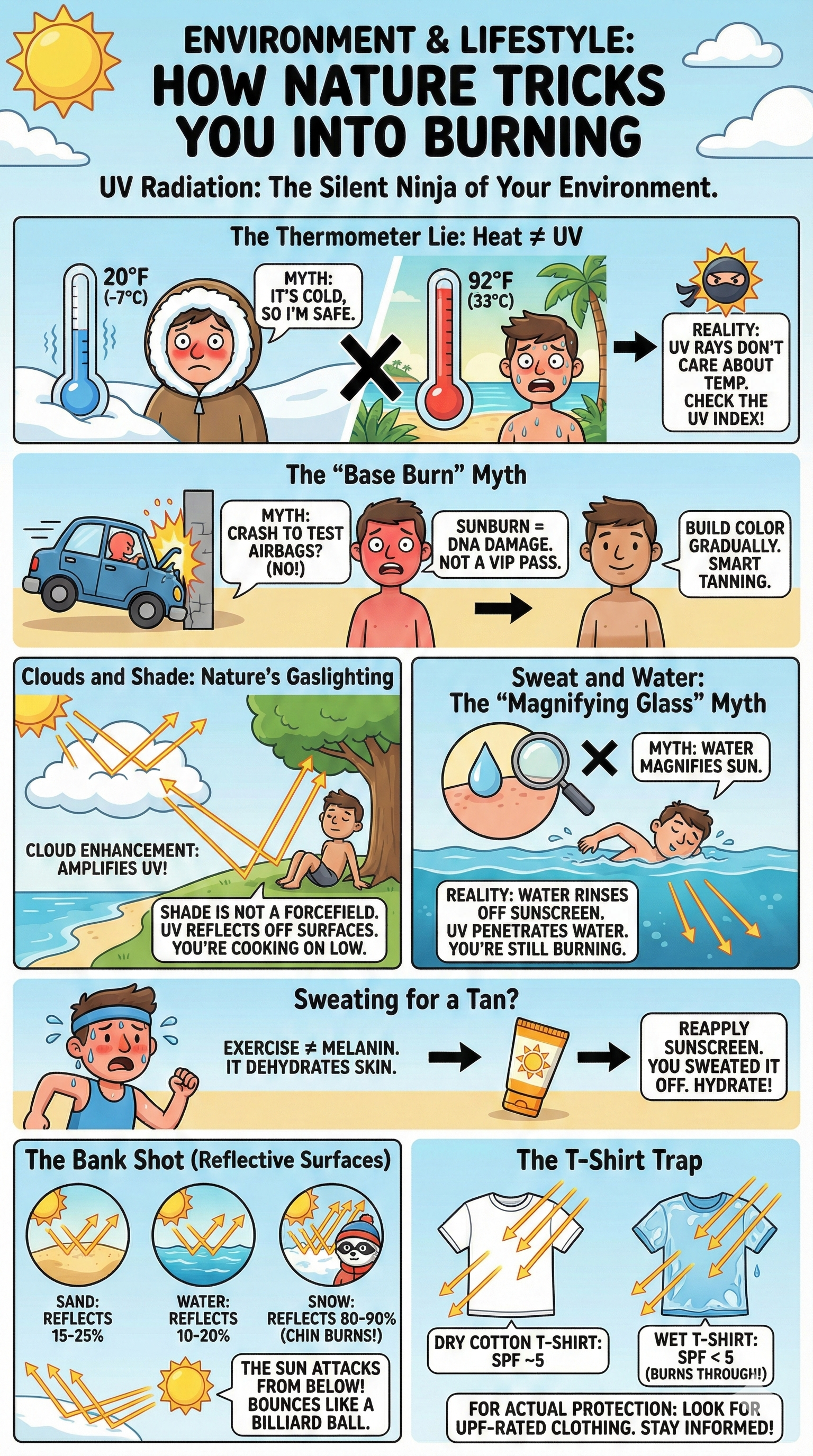
The Thermometer Lie: Heat ≠ UV
Myth: “It’s chilly today, so I can’t get sunburned.”
Also a myth: “It’s 92°F (33°C). Time to turn myself into a bronze god.”
Reality: Temperature has nothing to do with tanning. Zero. Nada.
You can scorch your nose at 20°F (–7°C ) on a snowy slope just as efficiently as at a tropical beach. Why? Because tanning is caused by UV radiation, not temperature.
Heat is just infrared radiation making you sweaty and cranky. UV radiation, meanwhile, is the silent ninja slipping past your defenses whether you’re roasting, freezing, or pretending to be emotionally stable.
Always check the UV Index, not the temperature.
The “Base Burn” Myth
Myth: “I need to burn first to turn it into a tan.”
Reality: This is like saying you need to crash your car to test the airbags. A sunburn is nothing but more DNA damage, not a VIP pass to a deeper tan.
After-burn tan can be deeper, but that’s because your skin is desperately trying to protect itself from the trauma you just inflicted. That tan isn’t higher quality; on the contrary, all it really does is speed up wrinkles and bump up your skin-cancer risk.
You can (and should) build color gradually without ever turning red. There is no such thing as a “healthy” sunburn.
Clouds and Shade: Nature’s Gaslighting
Myth: “It’s cloudy. I’m safe.”
Reality: Clouds are liars. Up to 90% of UV rays punch right through thin clouds.
In fact, due to a phenomenon called the “Cloud Enhancement Effect,” scattered clouds can actually amplify UV radiation by bouncing it around the atmosphere like a cosmic pinball before it hits you.
And while shade is helpful, it’s not a forcefield. UV rays reflect off the ground and hit you from the side. You are still cooking, just on a lower setting.
Sweat and Water: The “Magnifying Glass” Myth
Myth: “Water droplets on my skin magnify the sun and burn me faster.”
Reality: You are not an ant being tortured by a kid with a magnifying glass. Water droplets do not focus the sun enough to burn you. However, water does rinse off your sunscreen.
And remember: UV rays can penetrate water. Up to 40% of UV radiation reaches half a meter deep. You can get a solid sunburn while happily bobbing in the pool, totally unaware because the water feels cool. The sun thrives on irony.
Sweating for a Tan?
Myth: “Working out in the sun makes me tan faster because of the blood flow.”
Reality: Nope, it just makes you flush, sweaty, and more likely to erase your sunscreen with your own enthusiasm. That rosy glow isn’t a tan; it’s heat exhaustion trying to say hello. Exercise doesn’t boost melanin production. But it dehydrates your skin, making you more vulnerable to damage.
So hydrate and moisturize. Your skin is thirsty. Also, reapply sunscreen, because you definitely sweated it off during those burpees.
The Bank Shot (Reflective Surfaces)
Myth: UV rays only come from above.
Reality: The sun doesn’t just attack from above; it attacks from below. UV radiation bounces off surfaces like a billiard ball.
- Sand: Reflects 15–25%
- Water: Reflects 10–20%.
- Snow: Reflects 80–90%.
This is why skiers get raccoon eyes in winter and why you can burn under your chin, nose, and eyelids at the beach.
The T-Shirt Trap
Myth: Clothing blocks UV.
Reality: You can burn through your clothes. A standard light cotton T-shirt has an SPF of about 5. If it gets wet, that drops even lower.
Tighter weaves (like denim) block more UV, though wearing jeans on the beach is a different kind of suffering. For actual protection, look for UPF-rated clothing.
END OF CHAPTER