

“Why are you the way that you are?”
~Michael Scott, The Office
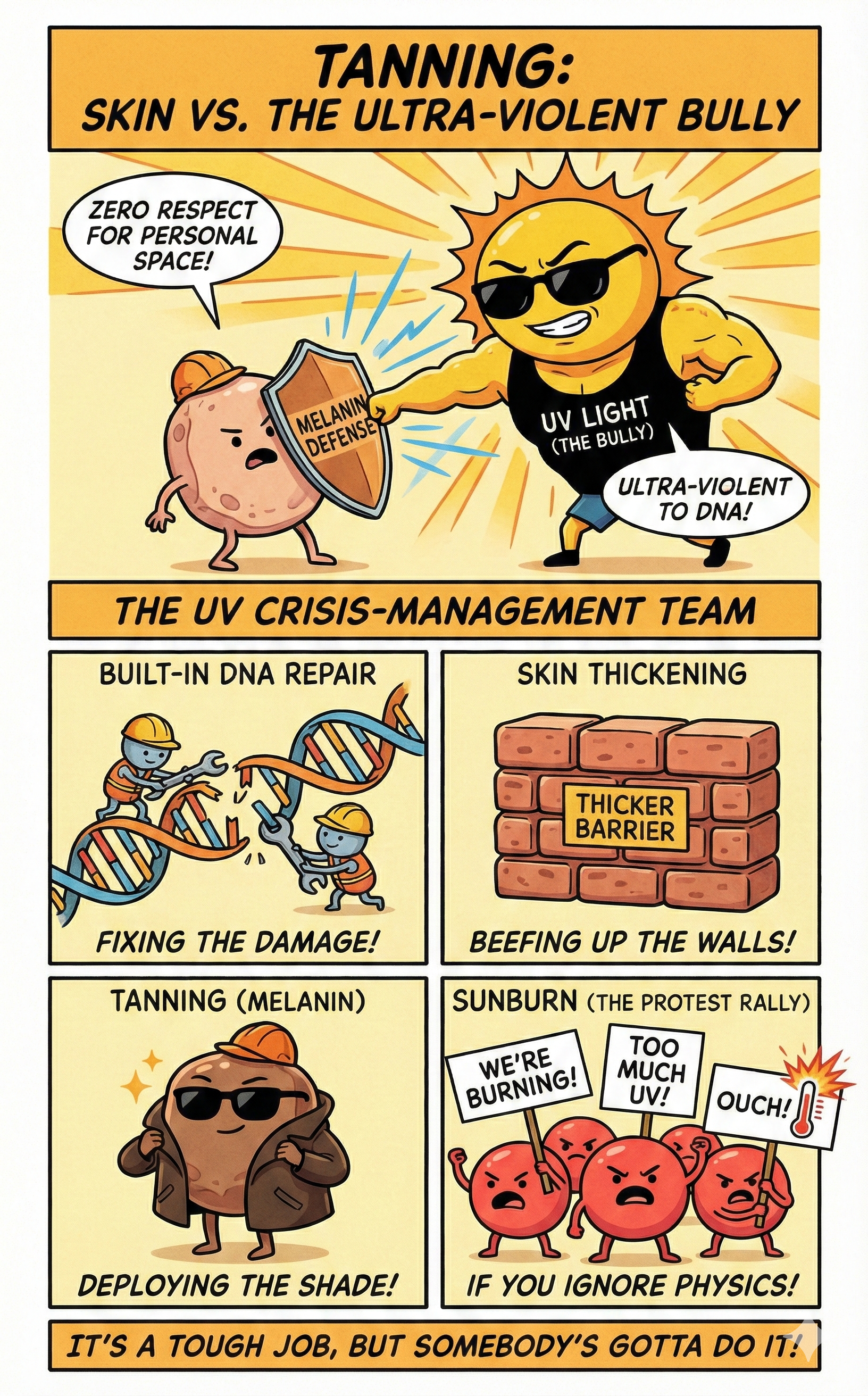
Let’s shed some light on the situation. A tan is simply your skin mounting a defense against a cosmic bully with boundary issues. The bully, of course, is ultraviolet (UV) light: “ultra-violet” when you write it down, “ultra-violeNt” when it messes with your DNA.
A tan isn’t your skin’s only line of defense. The whole UV crisis-management squad shows up: DNA repair crews, emergency skin-thickening protocols, and – if you insist on acting immune to the laws of physics – the bright-red protest march we call sunburn.
Meet the UV Family: The Good (Kind Of), the Bad, and the “Why You Here?”
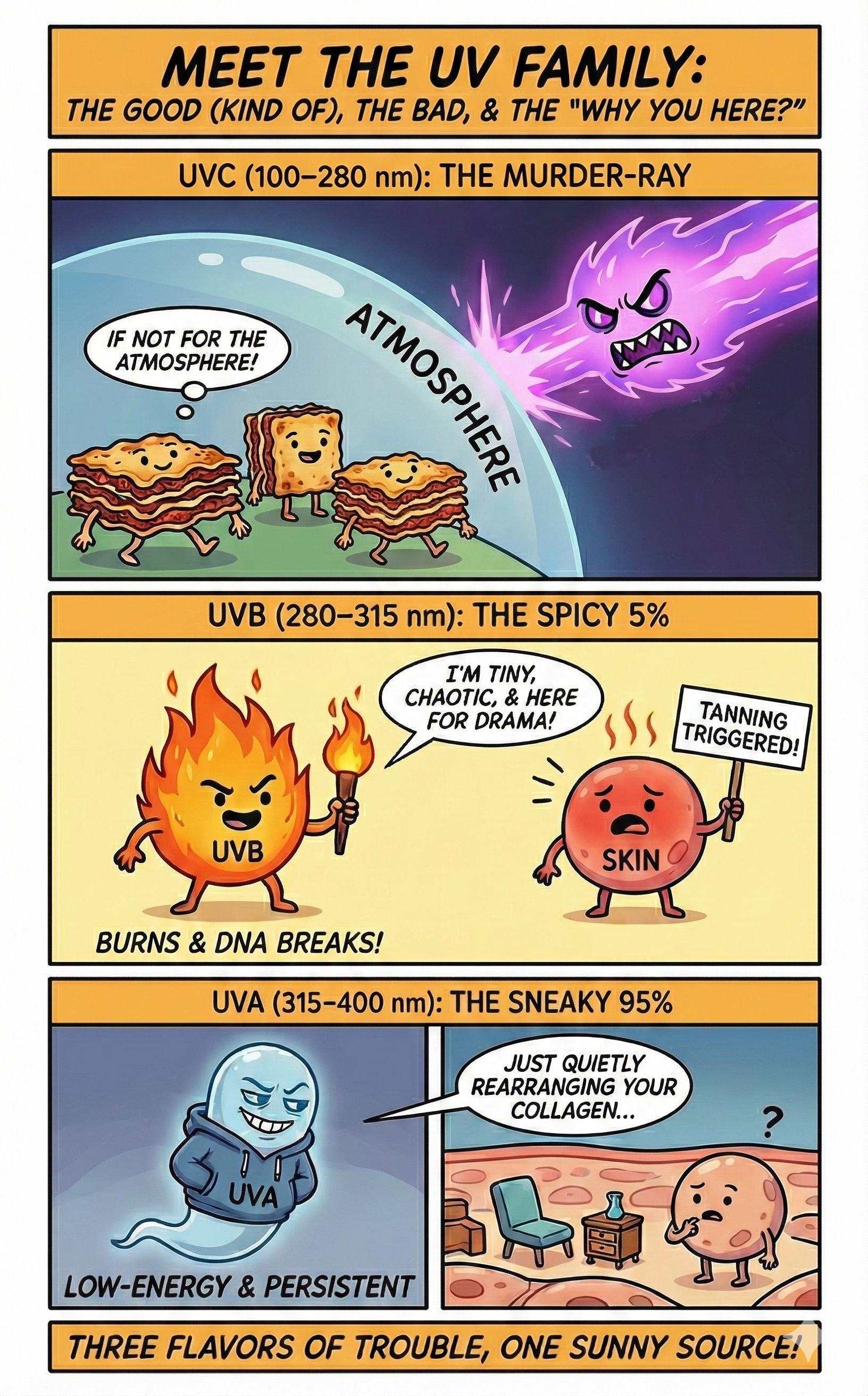
UV light comes in three distinct flavors of trouble:
- UVC (100–280 nm): the murder-ray. Thankfully, Earth’s atmosphere blocks all of it, or else we’d all be crispy, overdone lasagna noodles. With legs.
- UVB (280–315 nm): the spicy 5% of UV that actually reaches the ground. Causes burns, breaks DNA, triggers tanning. The middle child of UV: tiny, chaotic, and responsible for most of the family drama if left unchecked.
- UVA (315–400 nm): the remaining 95% of ground-level UV. Low-energy and chill at first, but sneaky, nosy, and extremely persistent. The passive-aggressive “friend” who quietly rearranges your furniture when you’re not looking.
“Whoa, hold on,” you might say, “Is this the part where I relocate permanently to a cave?” Well, fear not. In every great story, the antagonist is never pure evil; it’s usually a deeply complicated character, and UV light is no exception. As you’ll soon learn, it’s not always your foe; under the right circumstances, it might even be your reluctant ally. So keep reading; the plot thickens.
UVB: The DNA Demolition Expert
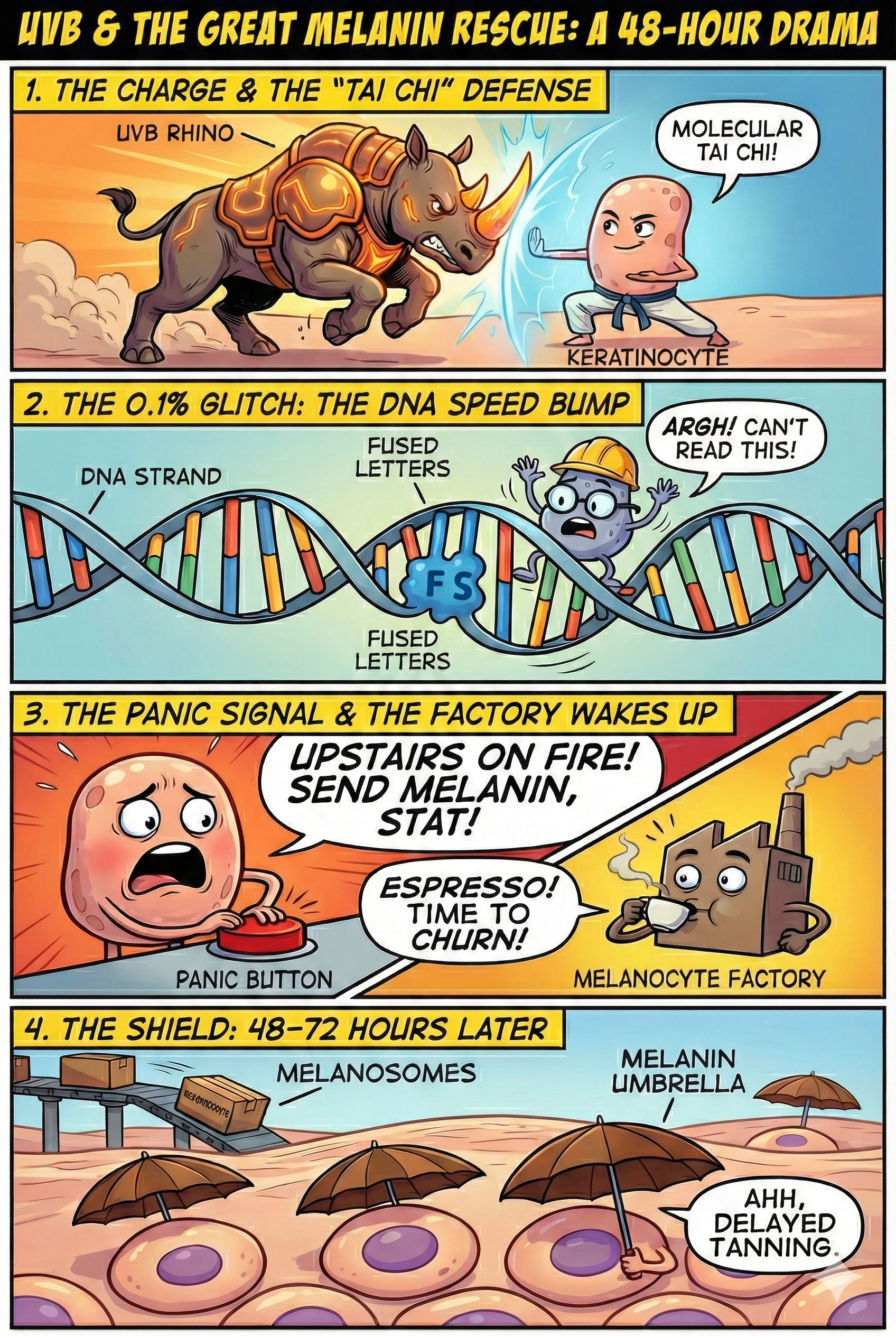
UVB is responsible for direct DNA vandalism. It charges into your surface skin cells – keratinocytes – like a caffeinated rhinoceros and tries to smash your genetic code. Most of the time, the cells shrug it off in a fraction of a second by doing molecular Tai Chi and dumping the extra energy as heat.
But in fewer than 0.1% of cases, UVB causes an actual glitch: it fuses two DNA letters together, creating a microscopic speed bump that confuses the enzymes reading your genetic script. It’s like trying to read a book where someone glued pages 40 and 41 together.
When this happens, your skin cells hit the biological panic button: “Uh hey, upstairs on fire, send melanin, STAT!”.
The melanin factories downstairs – melanocytes – wake up, chug an espresso, and start churning out melanin. They package it into melanosomes (tiny Amazon Prime boxes) and ship them upstairs.
Once delivered, this melanin opens up like a tiny beach umbrella over the cell’s nucleus, shielding your precious DNA from further beatings.
The entire operation takes 48–72 hours. This is Delayed Tanning that lasts weeks; the only tan that actually offers future protection against UV, because it’s made from fresh, purpose-built melanin rather than reheated leftovers.
UVA: The Silent Saboteur
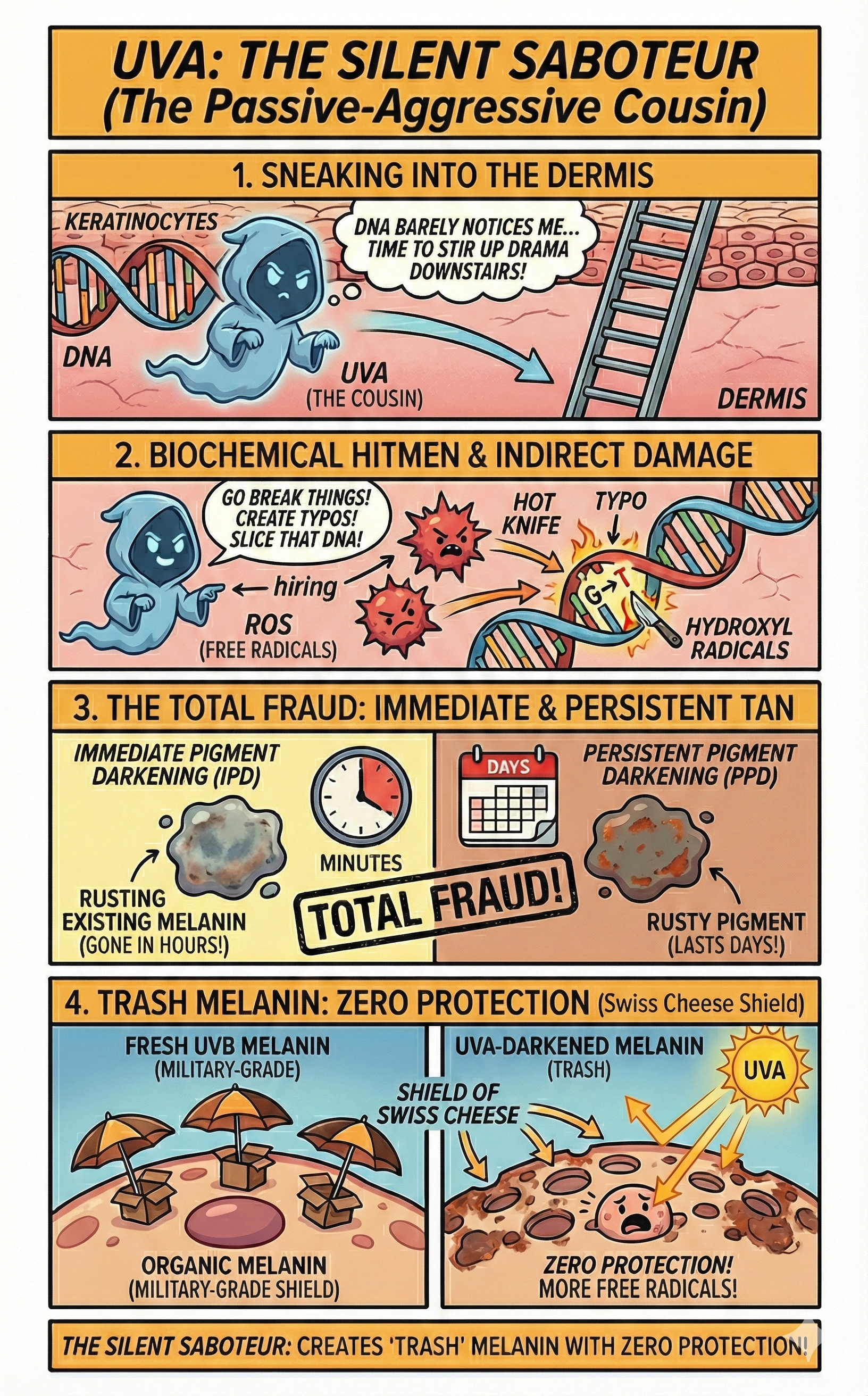
UVA is the passive-aggressive cousin. DNA barely notices it, so UVA does what any ignored family member does: heads downstairs to stir up drama in the dermis.
Instead of punching DNA directly, it hires biochemical hitmen called Reactive Oxygen Species (ROS). These are chemically unstable oxygen molecules (free radicals) that run around breaking things. They may cause indirect DNA damage, like G→T transversions; basically inserting typos in your DNA code, turning a perfectly good gene into a confused protein.
UVA’s other trick of the trade is creating hydroxyl radicals (think “free radicals on steroids”) by stirring hydrogen peroxide and oxygen into something that can slice through DNA like a hot knife through butter.
UVA can also give you a “tan”, but it’s a total fraud with two different optical illusions, equally disappointing:
• Immediate Pigment Darkening (IPD): This happens in minutes. It has a grayish tint. It’s not new melanin; it’s just the UVA oxidizing (rusting) the melanin you already have. It is gone in hours.
• Persistent Pigment Darkening (PPD): Looks more “tan-like” but lasts just a few days. It’s simply that rusty pigment getting pushed to the surface.
Why it sucks? This oxidized melanin is trash. It’s disorganized and lazy. Unlike the fresh, military-grade melanin produced by UVB, UVA-darkened melanin provides zero protection. In fact, because nature enjoys plot twists, this “melanin” might actually generate more free radicals. It’s a shield made of Swiss cheese.
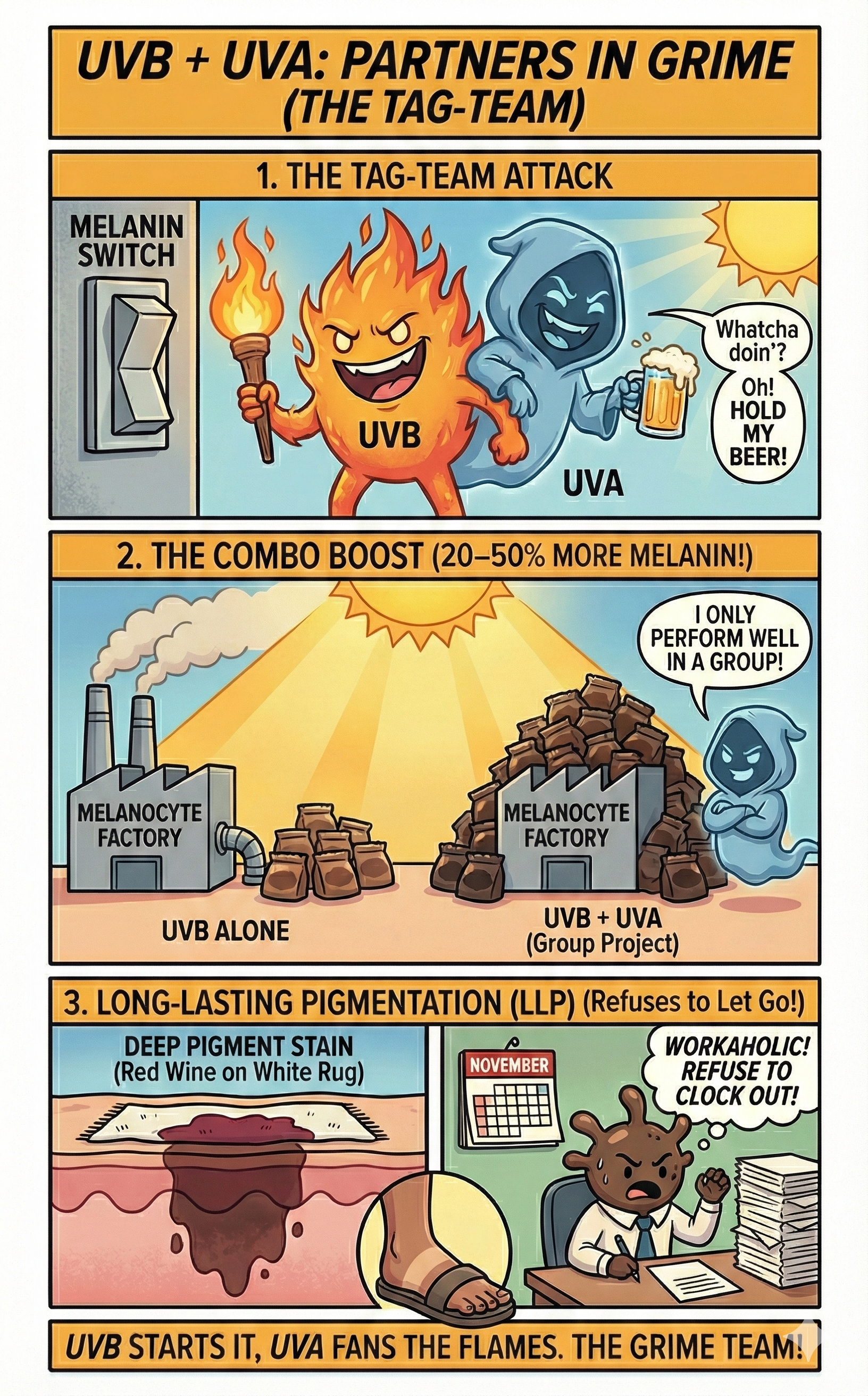
UVB + UVA: Partners in Grime
Out in the real world, however, UVB and UVA don’t show up one at a time; they tag-team you, especially when the sun is high. UVB flips the melanin switch, and UVA leans over its shoulder like, “Whatcha doin’? Oh! Hold my beer!”
Experiments with solar-simulated light show that the combo of UVA and UVB boosts melanin output by 20–50% more than UVB alone. Which is funny, because UVA by itself does almost nothing. Classic “I only perform well in a group” situation.
Sometimes, this collaboration works a little too well. There’s this phenomenon some people experience called Long-Lasting Pigmentation (LLP), where the skin simply refuses to let go of the past; the color just sticks around for months. Why? Scientists aren’t 100% sure, but the leading theory is that the pigment settles in too deep like red wine on a white rug, or perhaps the melanocytes just turn into total workaholics who refuse to clock out. So if you still have sandal lines in November, congratulations: you have LLP.
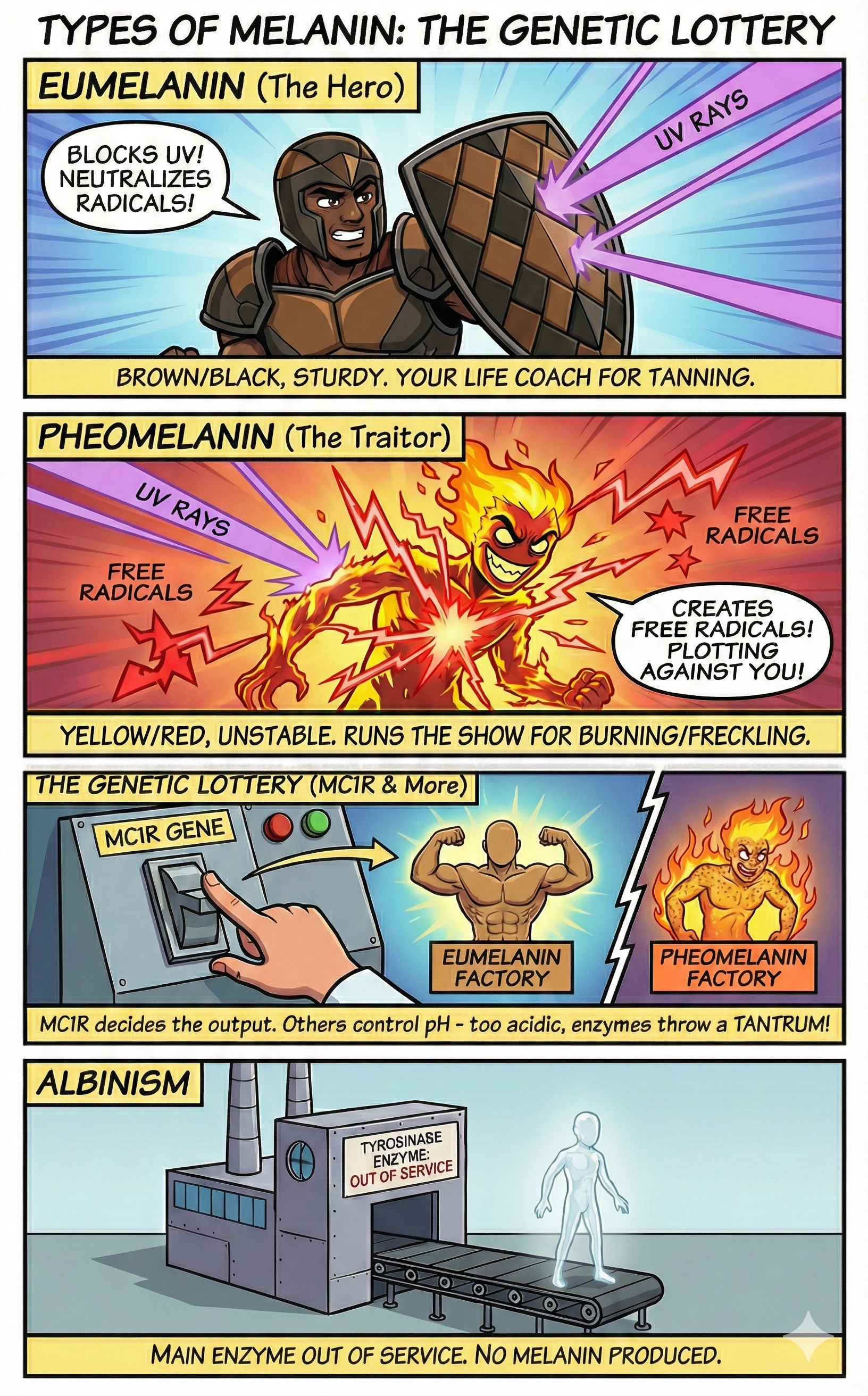
Types of Melanin: The Genetic Lottery
To make things more “interesting”, not all melanin pigment is on your side:
- Eumelanin The Hero. Brown/black, sturdy, blocks UV, neutralizes radicals.
- Pheomelanin The Traitor. Yellow/red, unstable. When hit by UV, pheomelanin actually can create free radicals.
So if you burn easily, freckle, or are ginger-tinted: pheomelanin is running the show (and possibly plotting against you). If you tan like a Mediterranean demigod: eumelanin is your life coach.
Genes like MC1R are basically your pigment factory’s shift managers, deciding the ratio of eumelanin to pheomelanin in each batch. Others control melanosome pH, if it’s too acidic, your tanning enzymes throw a tantrum and slow down.
Albinism is what happens when the main melanin-making enzyme (tyrosinase) is out of service altogether.
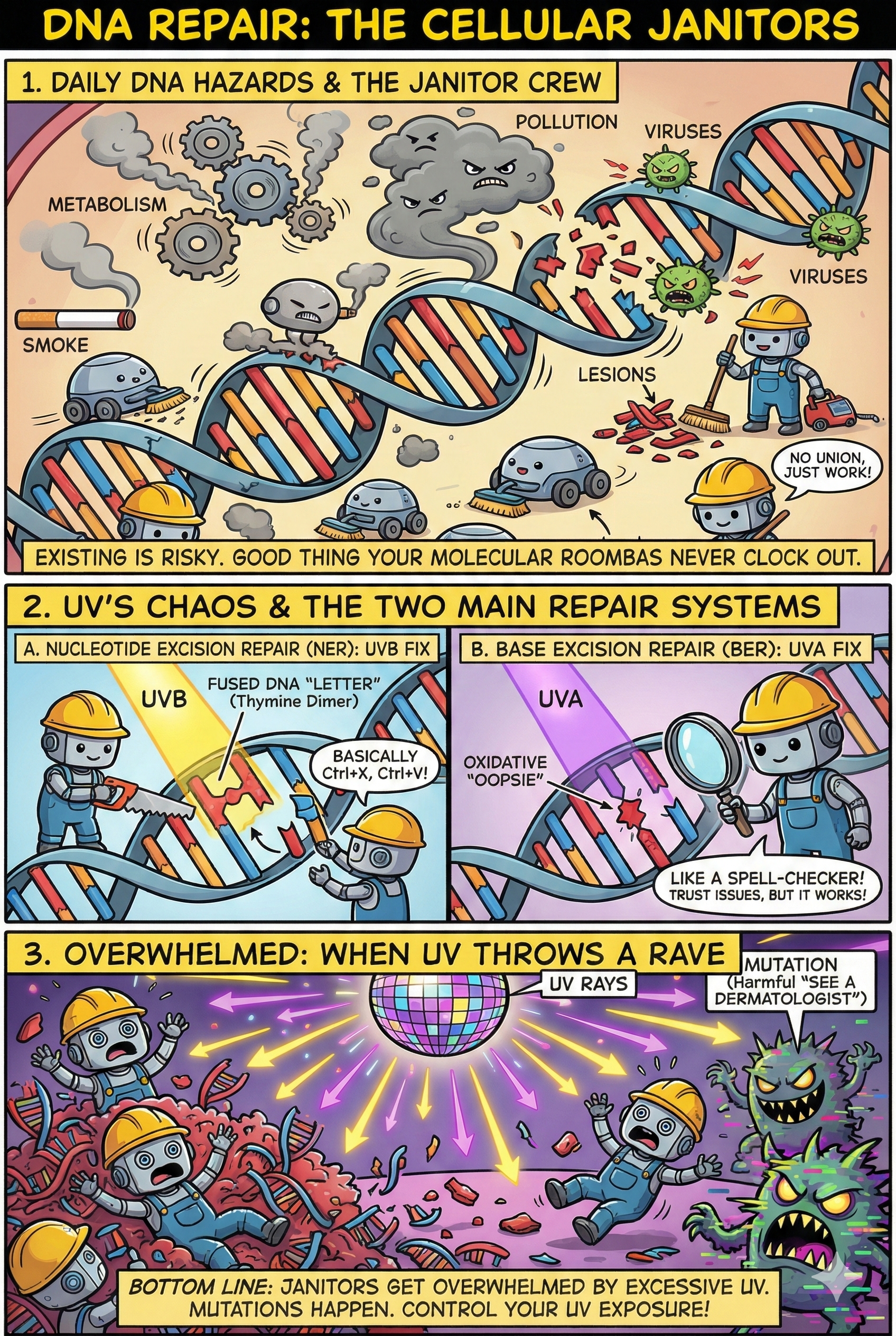
DNA Repair: The Cellular Janitors
So guess what: being alive is hazardous. Even without the sun, your cells rack up tens of thousands of DNA lesions every single day thanks to things like your natural metabolism, air pollution, cooking fumes, cigarette smoke (especially secondhand), background radiation, viruses, Mondays (just kidding… maybe).
Fortunately, your body has special repair crews: molecular Roombas constantly scooting around cleaning up spills, broken bits, and existential mistakes. They are fast, efficient, and they don’t unionize.
When it comes to undoing UV’s particular brand of chaos, your body uses two main repair systems:
- Nucleotide Excision Repair (NER): Fixes UVB’s signature damage – those fused DNA “letters.” It literally cuts out the bad chunk of DNA and pastes in a new one. Basically Ctrl+X, Ctrl+V (or ⌘+X, ⌘+V if you’re fancy).
- Base Excision Repair (BER): Fixes UVA’s oxidative “oopsies.” Swaps out the single corrupted letter like a molecular spell-checker with trust issues.
However, when UV throws a rave on your skin (like when you stay out too long and burn), these tiny janitors get overwhelmed, mistakes slip through, and that’s how mutations happen.
Some mutations are harmless, others are more like “please see a dermatologist.” Fortunately, UV exposure is one of the few DNA-damaging threats you can actually control.
Oh… one more thing: while UVB causes direct DNA damage and visible sunburn, UVA is the truly annoying one. Its damage happens deeper, creating oxidative chaos in the dermis, shredding collagen, unraveling elastin, and filing a hostile takeover on your skin structure.
This is why, for example, “UVA-dominant” high pressure tanning beds are… let’s say, a bold interpretation of what “safe” means. They promise “no burn,” but they conveniently forget to mention the fast-forward button that turns your skin into something Indiana Jones would carry documents in.
Sunburn: The Red Badge of Stupidity
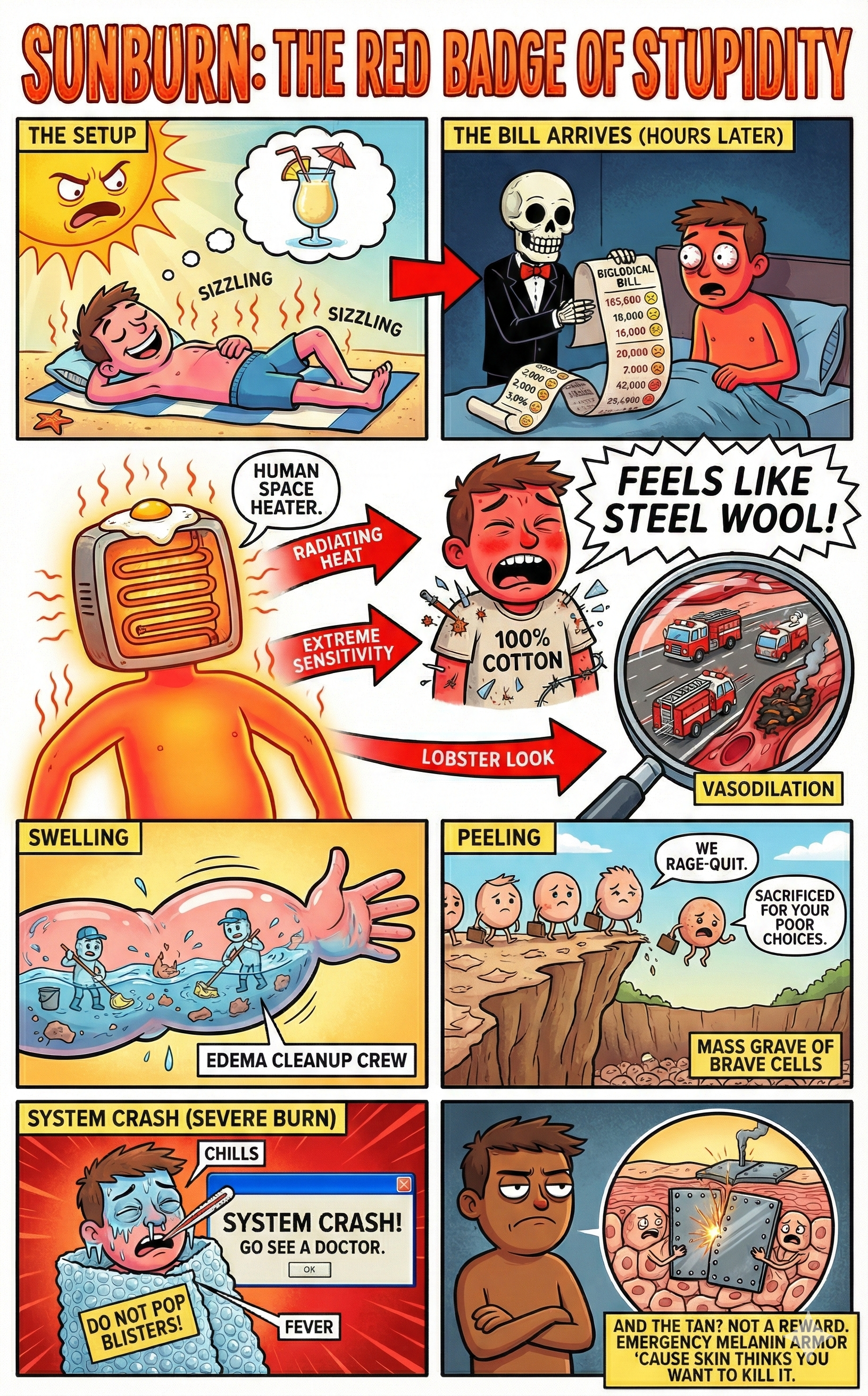
If tanning is a shield, sunburn is a siren. It’s the inflammatory response by your skin telling you you’ve made a terrible mistake.
Sunburn is a master of deception. It rarely appears immediately. You can feel totally fine while sitting on the beach, unaware that you are actively cooking. The pain and redness usually arrive 6–24 hours after the damage is done. It is the biological equivalent of a hangover: you had your fun in the sun, and now your body is sending you the bill.
When the bill arrives, it includes:
- Radiating heat: You are now a human space heater.
- Extreme sensitivity: Your nerves are on high alert, meaning even a soft t-shirt feels like it’s made of steel wool and insults.
- The “Lobster” look: This is caused by vasodilation – your blood vessels widening to rush immune cells to the disaster zone, like fire trucks to a five-alarm blaze.
- The swelling: This is edema, fluid rushing in to cushion the blow and help the immune system mop up the cellular debris.
- The peeling: That gross peeling layer a few days later? That isn’t just dry skin. That is a mass grave of brave skin cells that sacrificed themselves to save you from your own poor decision-making. They are “rage-quitting” life to prevent mutations from spreading.
- The system crash (severe burns): Blisters, fever, chills? Congratulations, you have upgraded to “Sun Poisoning.” Blisters are nature’s sterile (and forbidden) bubble wrap (do not pop them!), and the fever is your body in full emergency broadcast mode. If you reach this stage, stop reading this and go see a doctor; your immune system is filing a union grievance.
And the deep tan you get after a burn heals? That isn’t a reward for enduring the pain. That is your skin desperately slathering on melanin armor plating because it thinks you’re trying to kill it.
Skin Thickening: The Biological Armor
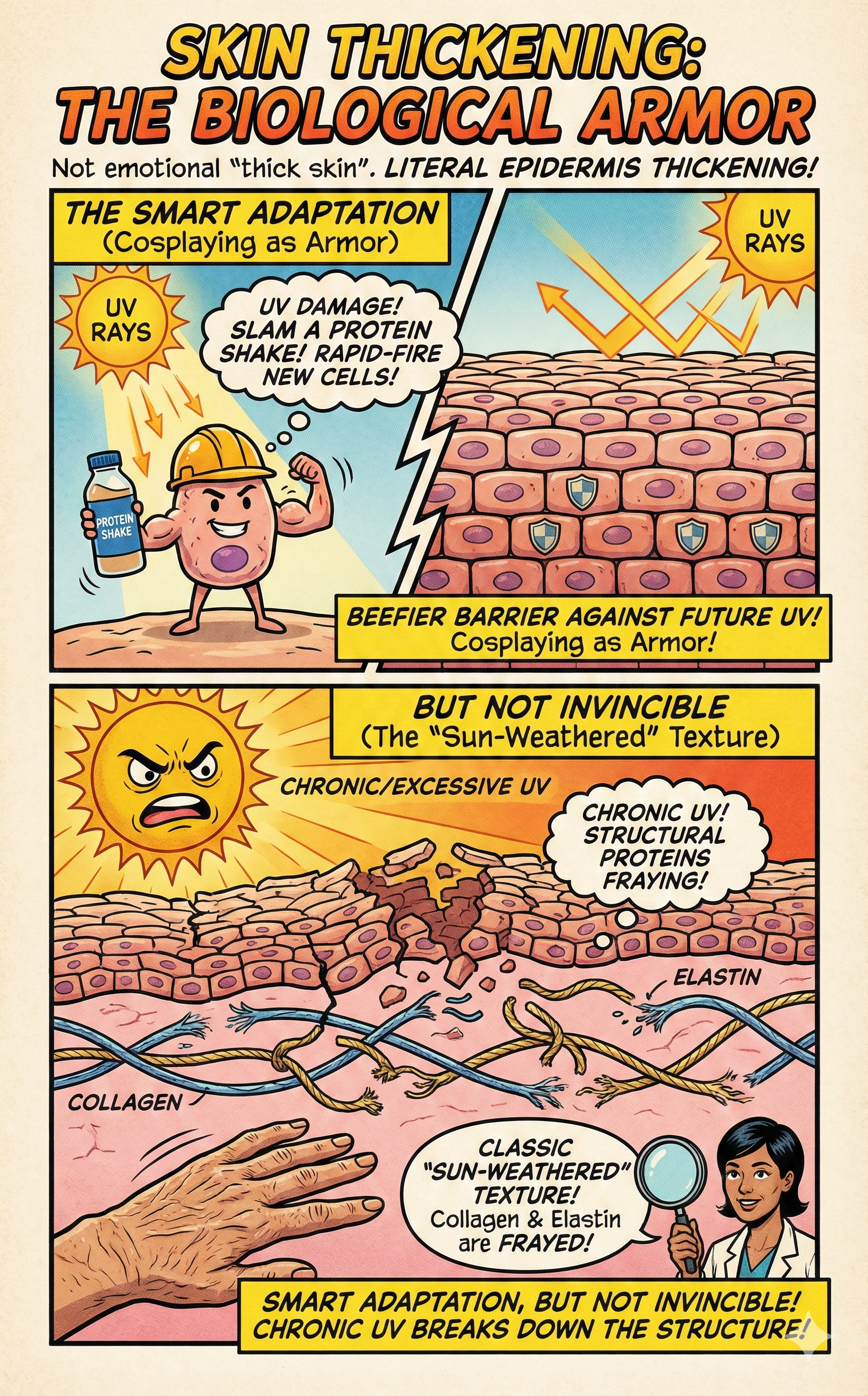
Your skin doesn’t just tan in response to UV, it can also thicken. Not the emotional sort of “thick skin” you develop after bad dates or performance reviews. This is literal thickening of the epidermis.
Keratinocytes sense UV damage, slam a protein shake, and start rapid-firing new cells upward to create a beefier barrier against future UV. Your skin is basically trying to cosplay as armor.
It’s a smart adaptation, but not invincible. With enough chronic (and especially excessive) UV, structural proteins in the dermis (collagen, elastin) begin to fray, leading to the classic “sun-weathered” texture dermatologists love diagnosing.
END OF CHAPTER