

“Oh no, not again.” ~Petunias, The Hitchhiker’s Guide to the Galaxy
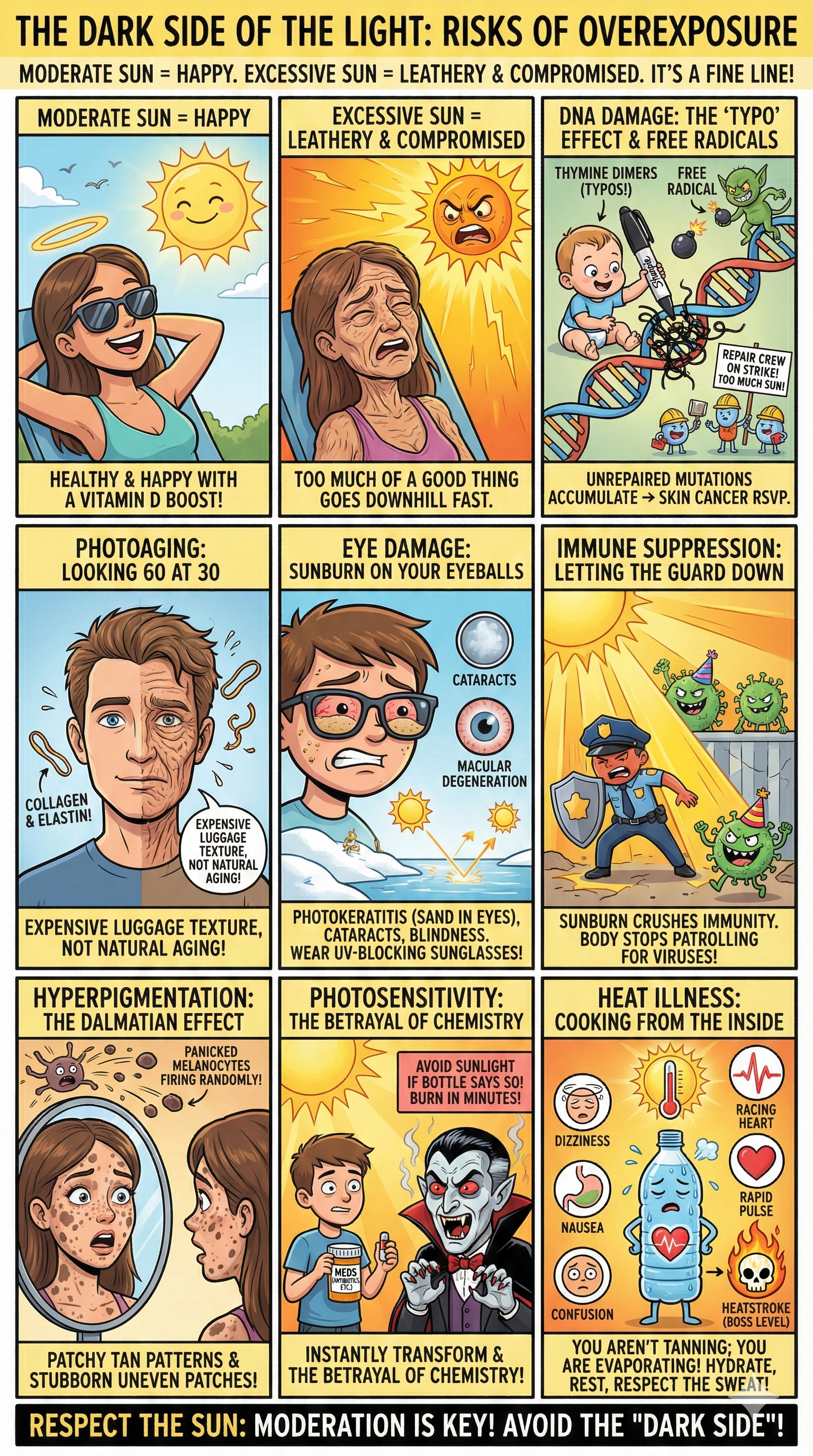
Moderate sun makes you healthy and happy. Excessive sun makes you leathery and cellularly compromised. It is a fine line, just like coffee, wine, and reality TV, too much of a good thing goes downhill fast.
The same rays that give you Vitamin D can, in higher doses, rewrite your genetic code and turn your skin into an old catcher’s mitt.
Previous chapters have already politely warned you about overexposure. This section is the encore, because when it comes to sun damage, repetition isn’t annoying; it’s survival.
Here is what happens when you ignore the warnings.
DNA Damage: The “Typo” Effect
UVB light acts like a toddler with a sharpie drawing on your DNA. It creates thymine dimers, little molecular knots that distort your genetic code. UVA is sneakier: it doesn’t draw on your DNA directly, it just wrecks DNA indirectly by unleashing free radicals to do its dirty work.
Your body has enzymes that fix these typos. If you tan too hard or too often, however, the repair crew goes on strike. Unrepaired mutations accumulate, leading to skin cancer (basal cell, squamous cell, and the big bad, melanoma – all RSVP).
Shade, sunscreen and moderation all buy your repair crew time to catch up.
Photoaging: Looking 60 at 30
UVA rays dive deep past the epidermis into the dermis and snap your collagen and elastin fibers like old rubber bands, resulting in sagging, deep wrinkles, dryness, and a texture best described as “expensive luggage.” This isn’t “natural aging.” This is you actively destroying your skin’s structural integrity.
Antioxidants may help, but nothing beats moderation and balance, because once collagen leaves the chat, it’s not coming back easily.
Eye Damage: Sunburn on Your Eyeballs
Your eyes are incredibly sensitive. Unprotected exposure can cause:
- Photokeratitis: A sunburn on your cornea. It feels like sand in your eyes.
- Cataracts: Clouding of the lens.
- Macular Degeneration: Going blind later in life.
Snow, sand, and water act as mirrors, blasting UV into your eyes from below. Wear UV-blocking sunglasses, unless you hate seeing.
Immune Suppression: Letting the Guard Down
While a little sun boosts immunity, a lot of sun crushes it. A bad sunburn suppresses your immune system’s ability to fight off infections. Your body is so busy trying to fix the skin damage that it stops patrolling for viruses.
Hyperpigmentation: The Dalmatian Effect
When you abuse your melanocytes, they panic and start firing pigment randomly. The result: Freckles, dark spots, age spots, melasma flare-ups, patchy tan patterns that look like you applied sunscreen during an earthquake.
Darker skin individuals aren’t immune, pigment cells can still react strongly to too much UV, often in the form of stubborn uneven patches.
Photosensitivity: The Betrayal of Chemistry
Certain meds turn you into a vampire. Antibiotics, diuretics, and retinoids can make you burn in minutes. If the bottle says “Avoid Sunlight,” believe it.
Heat Illness: Cooking from the Inside
Humans are mostly water. If you sit in the sun until you are dizzy, confused, and your heart is racing, you aren’t tanning; you are evaporating. Prolonged sun time increases risk of dehydration, heat exhaustion, heatstroke (the boss level).
Symptoms include dizziness, nausea, confusion, rapid pulse: none of which pair well with a beach day. Hydrate, rest, and respect the sweat.
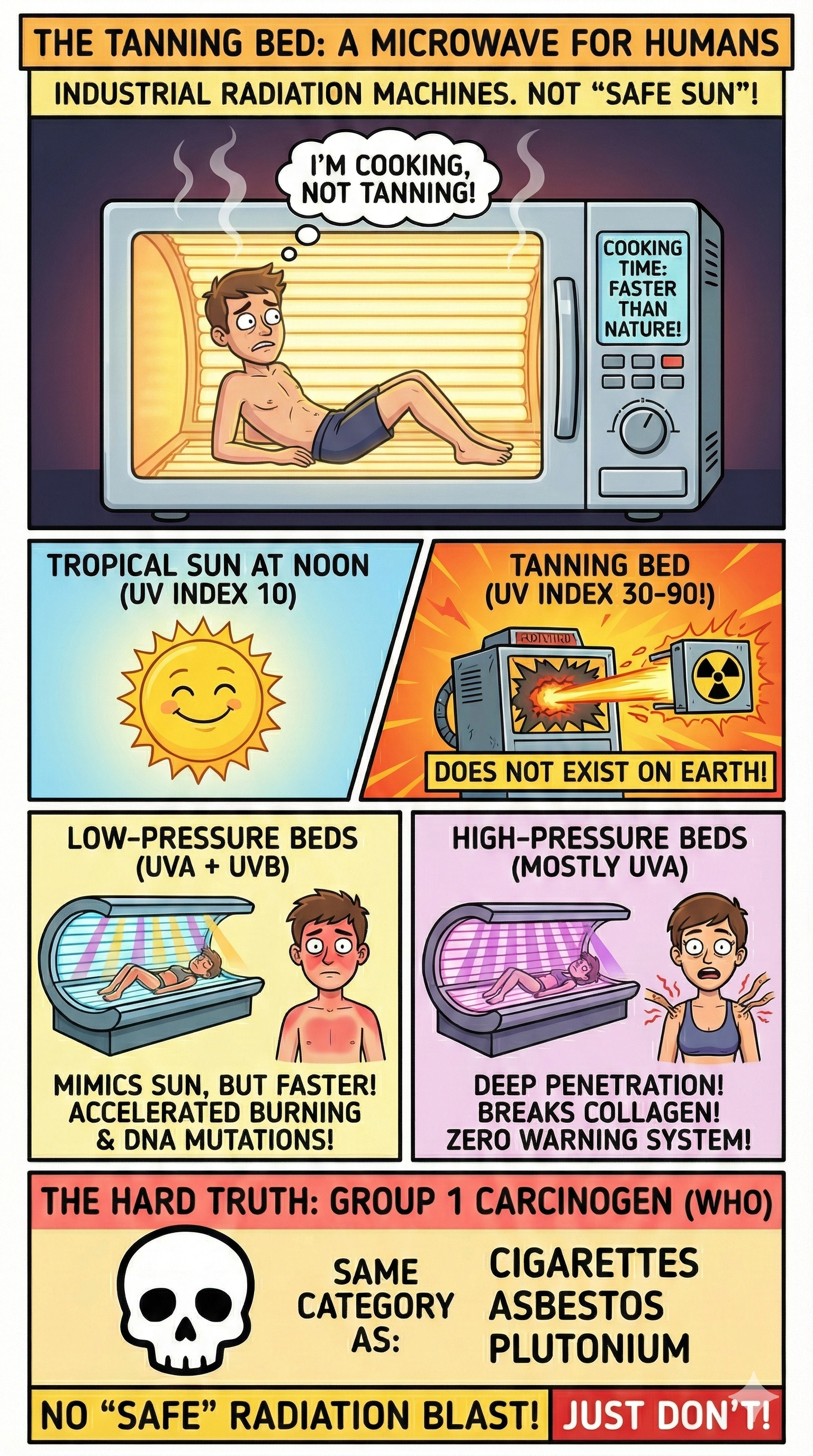
The Tanning Bed: A Microwave for Humans
Tanning beds are not “safe sun.” They are industrial radiation machines designed to tan you faster than nature ever intended.
A typical tanning bed blasts you with UV levels 3 to 6 times stronger than the tropical sun at noon. That is a UV Index of 30 to 90, a range that does not exist on planet Earth.
Here’s what those different machines are doing to you:
Low-pressure beds (UVA + UVB)
These mimic the sun slightly better because they include UVB, the wavelength responsible for delayed tanning (the kind that involves real melanin buildup and slightly better natural protection).
But the catch is that they still deliver UVB far faster and harder than nature, so you get accelerated burning and DNA mutations.
High-pressure beds (mostly UVA)
These give you a “gorgeous bronze” in record time, with none of the protective melanin you’d get from natural UVB exposure. UVA penetrates deep, drives oxidative stress, breaks collagen, and racks up long-term cancer risk while providing zero sunburn warning system.
This is why the World Health Organization classifies tanning beds as a Group 1 Carcinogen. They are in the same category as cigarettes, asbestos, and plutonium. There is no “safe” way to blast yourself with radiation that doesn’t exist in nature.
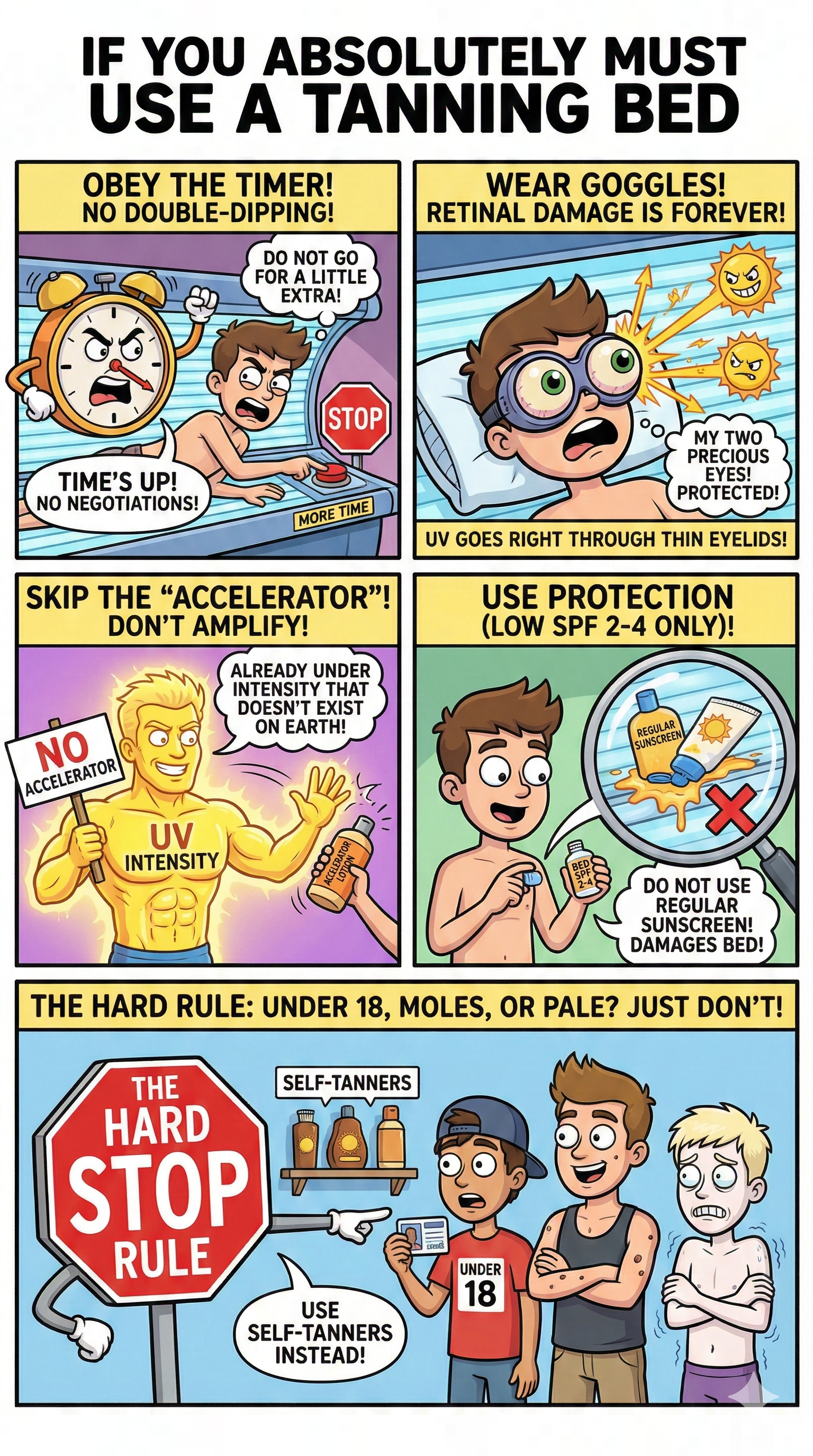
If you absolutely must use a tanning bed:
- Obey the timer: Follow the manufacturer’s schedule. Do not double-dip. Do not “go for a little extra.” Tanning beds don’t negotiate.
- Wear goggles: Eyelids are thin. UV goes right through them. Retinal damage is forever. You only get two eyes. Protect them.
- Skip the “Accelerator”: You are already under UV intensity that doesn’t exist on Earth; you don’t need to amplify it.
- Use protection: A very low SPF specially formulated for beds might slow the damage slightly without blocking the tan entirely. Do NOT use regular sunscreen inside a bed; it can damage the bed’s acrylic shield.
- The hard rule: If you are under 18, have moles, or are pale… just don’t. Use self-tanners.
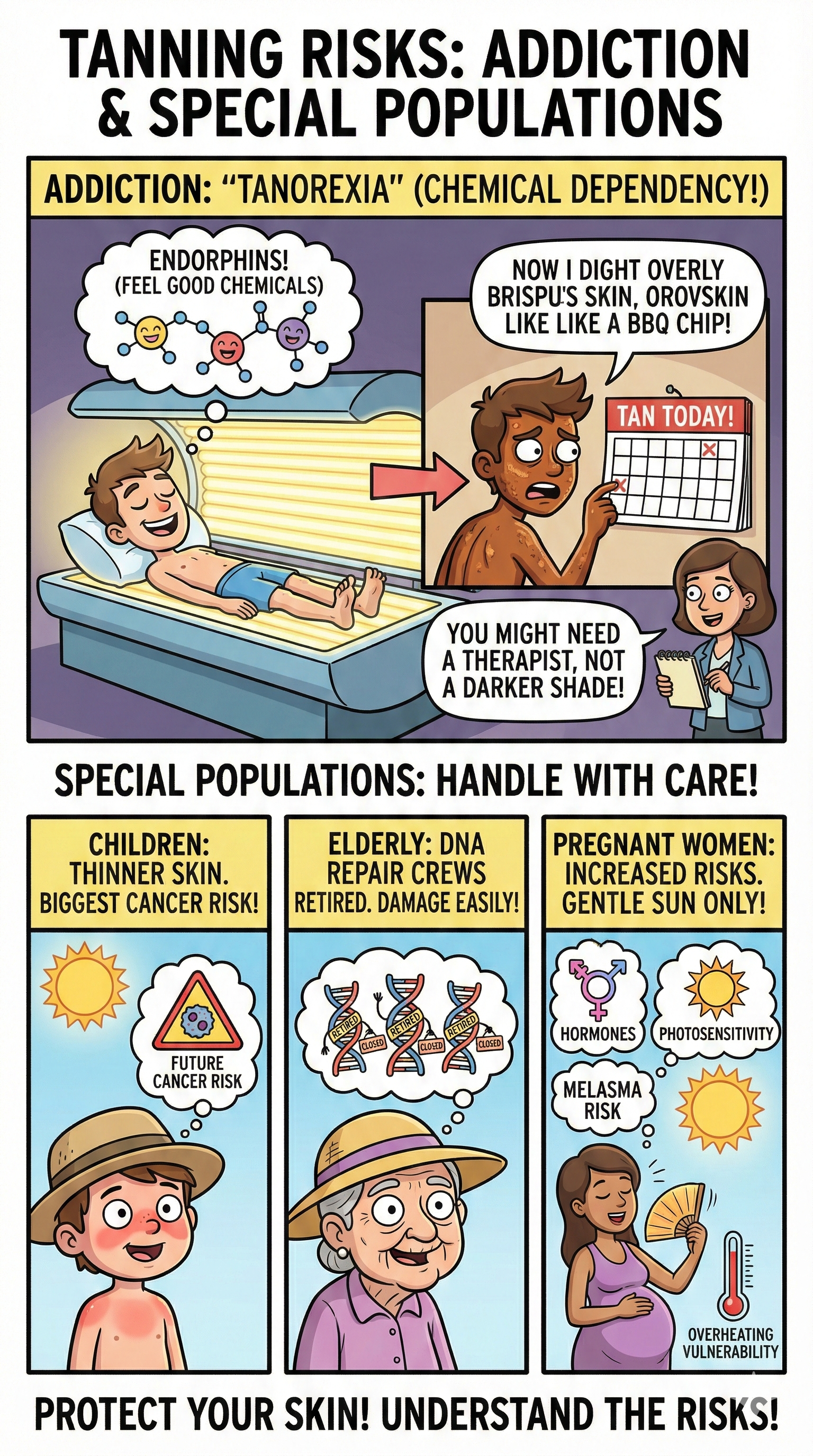
Addiction: “Tanorexia”
Tanning releases endorphins. For some, this creates a literal chemical dependency. If you find yourself compulsively needing to tan despite achieving a level of crispiness normally reserved for BBQ competitions, you might need a therapist, not a darker shade.
Special Populations
- Children: Their skin is thinner. Sunburns in childhood are the biggest predictor of cancer later.
- The Elderly: Their DNA repair crews are retired. They damage easily.
- Pregnant Women: Hormones increase photosensitivity, melasma risk, and overheating vulnerability. Gentle sun is fine; overexposure is not.
END OF CHAPTER