

“Even the smallest person can change the course of the future.”
~Galadriel, Lord of the Rings
By now, you’ve learned how sunlight tickles your skin cells, how tanning actually works, and how UV can be both your vitamin-D fairy and your DNA-scribbling gremlin. It’s a lot, and yes: it can feel confusing. The sun isn’t purely friend or foe; it’s more like that friend who’s amazing in moderation but becomes a disaster after two drinks.
Too much sun carries risks, too little has consequences of its own. Ultimately, you get to choose how to balance those trade-offs.
So here’s the practical part: a simple routine that turns all that photobiology into everyday skin sanity, helping you manage the risks while reaping the benefits.
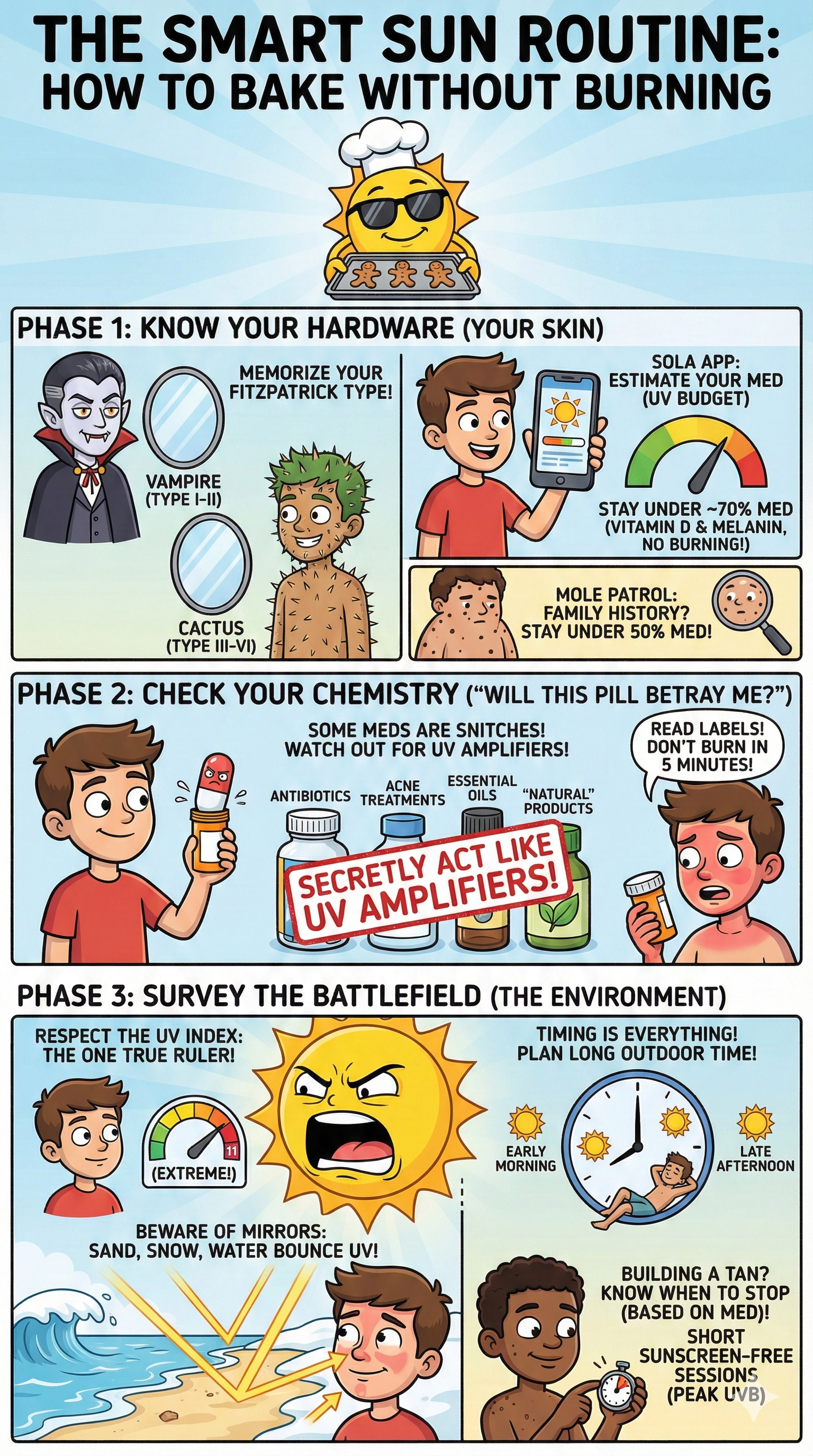
Phase 1: Know Your Hardware (Your Skin)
- Are you a vampire or a cactus? Figure out and memorize your Fitzpatrick Type like it’s your blood type: https://sunsplashtans.com/indoor_tanning/skin-type
- Understand your personal MED – your skin’s “UV budget” before it turns pink. Apps like Sola can estimate this for you. Sorry – had to mention it again 🙂
- Staying under ~70% of your MED gives you plenty of vitamin D and melanin action, without overwhelming your DNA repair crew.
- If you have lots of moles or a family history of skin cancer, don’t go above 50% of your MED.
Phase 2: Check Your Chemistry (“Will This Pill Betray Me?”)
- Some meds are snitches; don’t let them betray you. Watch out for antibiotics, acne treatments, essential oils, and “natural” products that secretly act like UV amplifiers.
- Read your labels. You don’t want to burn in 5 minutes because you took a pill for your headache.
Phase 3: Survey the Battlefield (The Environment)
- Respect the UV index; it is the one true ruler of sunburn risk. If the index is 11, the sun is shouting at you. Listen to it.
- Beware of mirrors: sand, snow, and water bounce UV rays into places the sun doesn’t usually shine (like up your nose).
- Timing is everything. Plan long outdoor time for early morning or late afternoon.
- If you are type III-VI and building a tan, you may choose short, sunscreen-free sessions when UVB is highest; just know when to stop based on your MED (see Phase 1 above).
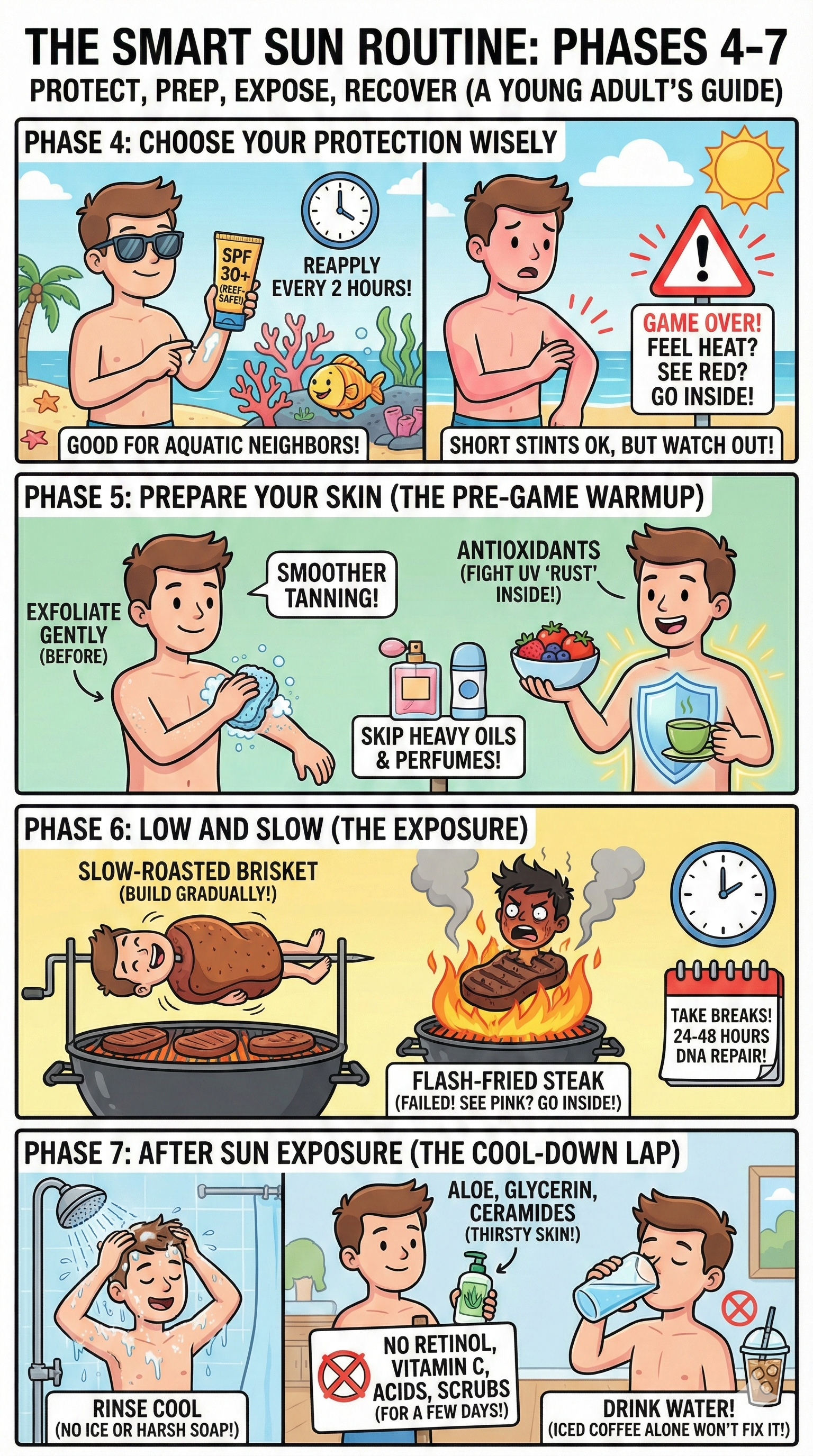
Phase 4: Choose Your Protection Wisely
- Fair or sensitive skin? History of skin issues? Outdoors for hours? Use SPF 30+ and reapply every 2 hours.
- You might not need heavy SPF for short stints, but keep an eye out. If you feel heat or see red, game over.
- Choose reef-safe, non-nano mineral sunscreens. Good for you and your aquatic neighbors.
Phase 5: Prepare Your Skin (The Pre-Game Warmup)
- Exfoliate gently a few hours before for smoother, more even tanning.
- Hydrate your skin, but skip heavy oils, perfumes, and deodorants right before sun.
- Eat berries, tomatoes, and green tea. Fill your body with antioxidants so it can fight the UV “rust” from the inside.
Phase 6: Low and Slow (The Exposure)
- You want to be a slow-roasted brisket, not a flash-fried steak. Build up your tan gradually.
- If you see pink, you have failed. Go inside.
- Take breaks. Your skin needs 24–48 hours to fix the DNA typos the sun caused. Give it the weekend off.
Phase 7: After Sun Exposure (The Cool-Down Lap)
- Rinse with cool water to remove sweat, salt, and sunscreen. Do not shock your skin with ice or strip it with harsh soap.
- Your skin is thirsty. Apply fragrance-free moisturizer with aloe, glycerin, panthenol, or ceramides.
- Avoid Retinol, Vitamin C, exfoliating acids, and scrubs for a couple of days.
- Drink water; your skin cannot repair itself on iced coffee alone.
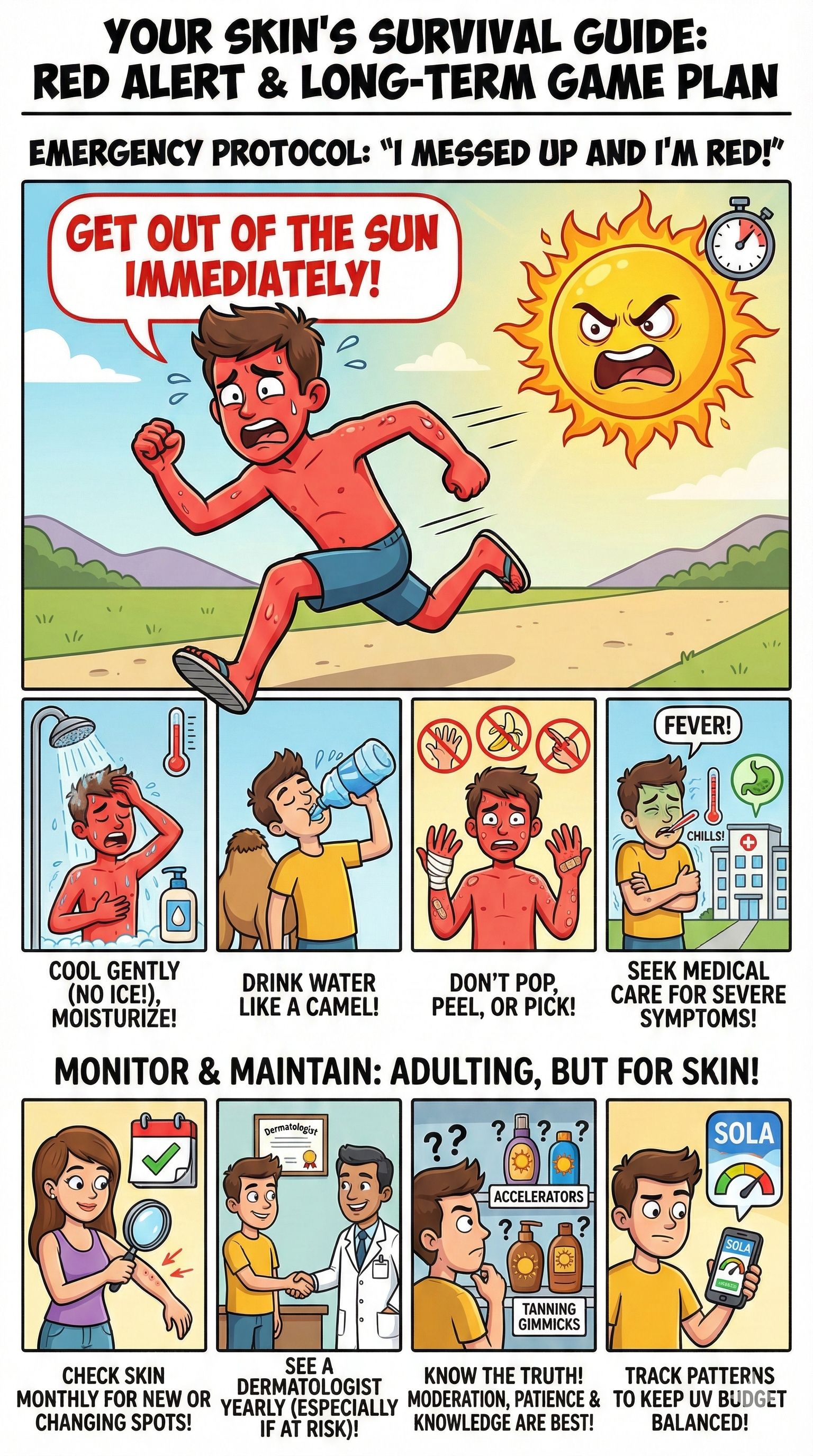
Emergency Protocol: “I Messed Up and I’m Red”
- Get out of the sun immediately. Cool gently (no ice), moisturize, hydrate.
- Drink water like a camel preparing for migration.
- Don’t pop blisters. Don’t peel. Don’t pick.
- Seek medical care if you experience fever, chills, nausea, or large burns.
Monitor & Maintain (Adulting, But for Skin)
- Check your skin monthly for new or changing spots.
- See a dermatologist yearly, especially if you tan often or have higher risk factors.
- Know the truth about accelerators, bronzers, and tanning gimmicks. Moderation, patience and knowledge are the best tanning products money cannot buy.
- Track patterns with pass like Sola to keep your UV budget balanced. Done advertising it 🙂 But seriously, give it a try!
PS: If this guide helped you level up your sun-smarts, send it to your friends, family, beach buddies, and anyone who tends to spontaneously combust after 20 minutes outside. Sharing is caring (and less burning).
END OF CHAPTER