

“There is no secret ingredient.”
~Mr. Ping, Kung Fu Panda
So how come the exact same UV wavelengths (UVB) that give one person a golden vacation glow can turn another into a traumatized tomato?
The difference comes down to how much UV you’re soaking up and your personal genetic cocktail: a pre-loaded mix of eumelanin (the reliable bodyguard) and pheomelanin (the unstable wildcard). That recipe is what pretty much sets your skin type.
The Fitzpatrick Scale: Tan or Burn?
Scientists love putting things into tidy little boxes with labels, and dermatologists are no exception. They use the Fitzpatrick Skin Type Scale: the official chart of your built-in sun tolerance, ranging from fair skinned “Vampire Chic” Type I all the way to the “Practically Fireproof” Type VI.
Knowing your skin type isn’t just trivia, it’s the difference between a great day at the beach and muttering “never again” to the flaming-hot-Cheeto version of yourself in the mirror.
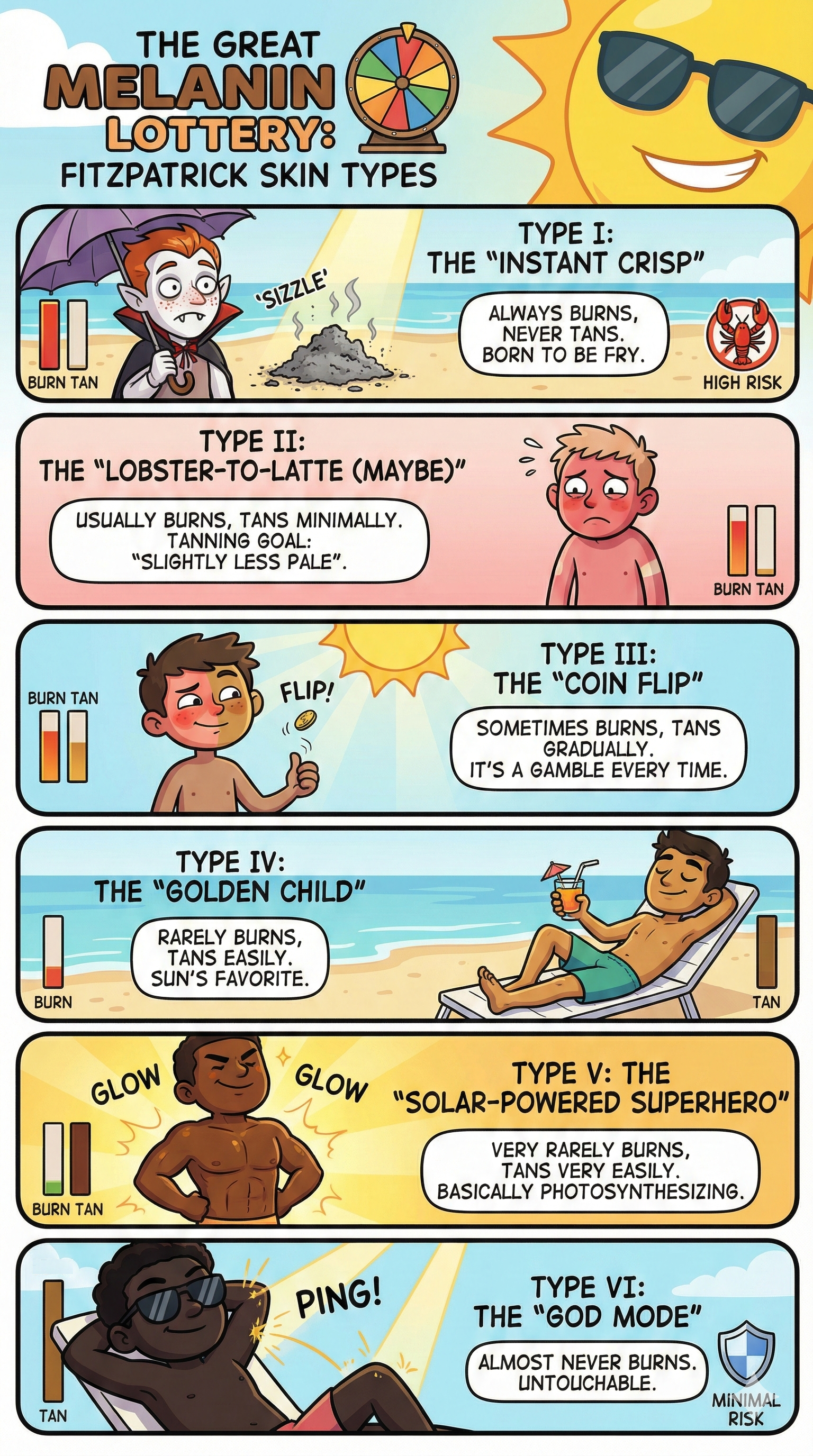
You can find out where you land on the scale by taking the questionnaire here:
https://sunsplashtans.com/indoor_tanning/skin-type
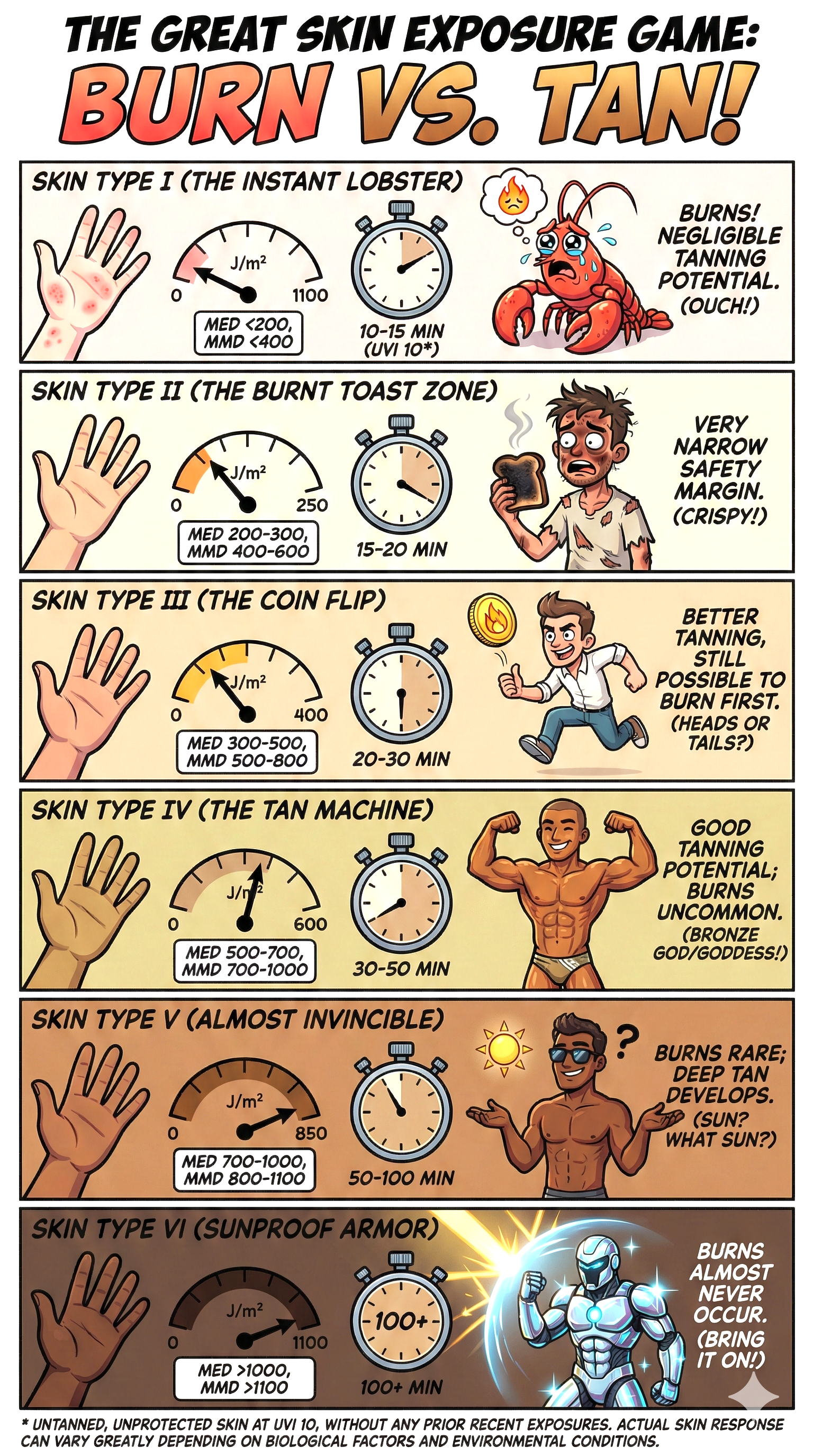
MED vs. MMD: Spot the Difference
Photobiologists – the folks who spend their days poking living things with light for a living – use two handy measurements to explain the eternal duel between burning and tanning:
- MED, Minimal Erythema Dose: The “Oops” Threshold. This is the smallest amount of UV needed to turn you pink (erythema) within 24 hours.
Erythema comes from a Greek-rooted term meaning “red,” a.k.a. your skin’s attempt at semaphore signaling that damage has occurred. - MMD, Minimal Melanogenic Dose: The “Glow” Threshold. This is the amount of UV needed to actually convince your skin to fire up the “melanin factory” to protect your DNA from future UV shenanigans.
The cruel math pulls a nasty trick on fair skinned folks: their burn threshold (MED) is crossed long before their melanin clock (MMD) even wakes up. There is no safety margin, there is only a “peeling margin.”
For darker skin types, these two numbers are closer together, meaning the melanin production usually kicks in before the damage becomes a visible disaster.
NOTE: MED and MMD are measured in Joules per square meter (J/m²). Don’t overthink the physics; just think of it as “Zaps of Energy” hitting a patch of skin the size of a beach towel.
The Loophole: How to Tan Without the Trauma
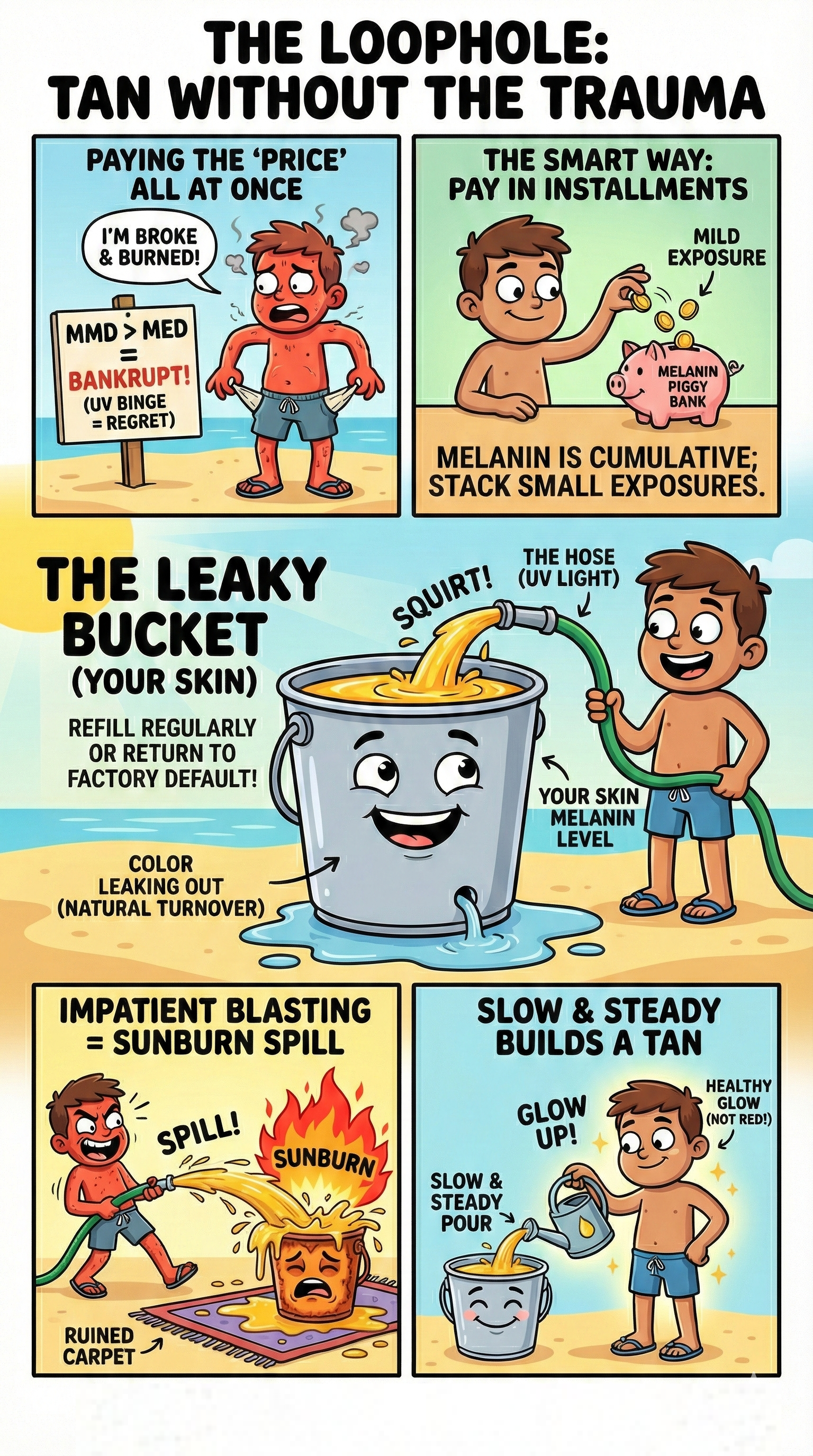
If the “price of tanning” (MMD) is higher than the “price of burning” (MED), how do you buy a tan without going bankrupt?
Simple: You pay in installments. Melanin production isn’t a sprint; it’s a cumulative project. You don’t need to hit your full tanning quota in one dramatic UV binge. Instead, you can “stack” mild exposures on top of each other.
Imagine your skin as a leaky bucket (yes, not the most flattering comparison but hang on – it’ll make sense in a moment), and you’re trying to fill it with a hose:
- The hose: This is you adding UV light to the system.
- The hole: This is natural skin cell turnover. If you don’t refill regularly, your color slowly leaks out until you return to your factory default setting.
- The spill: If you blast the hose too hard, the water rises faster than the bucket can handle, spills over the edge, and ruins the carpet. That’s a sunburn.
- The strategy: The goal is to pour in just enough to raise the level (get darker) without ever letting it spill over the rim (get red). Slow and steady builds and maintains a tan; impatient blasting equals regret.
The UV Index: How Mad is the Sun Today?
If your skin is the “leaky bucket,” the UV Index (UVI) is the size of the hose filling it.
The UVI is a global scale that measures exactly how aggressively the sun is trying to cook you. It ranges from 0 (the sun is sleeping) to 11+ (the sun has a personal vendetta against you). The higher the number, the faster your “bucket” can overflow into a burn.
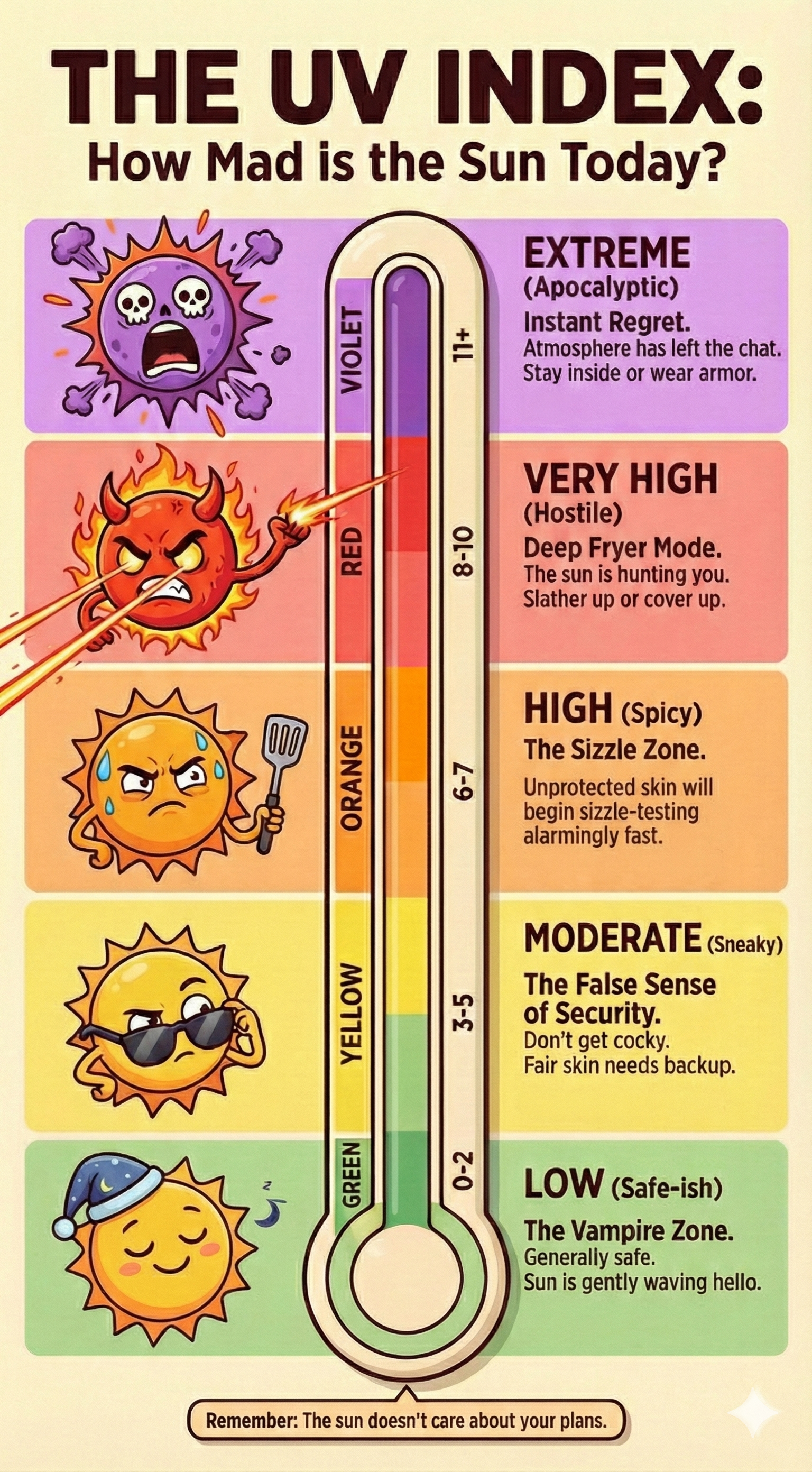
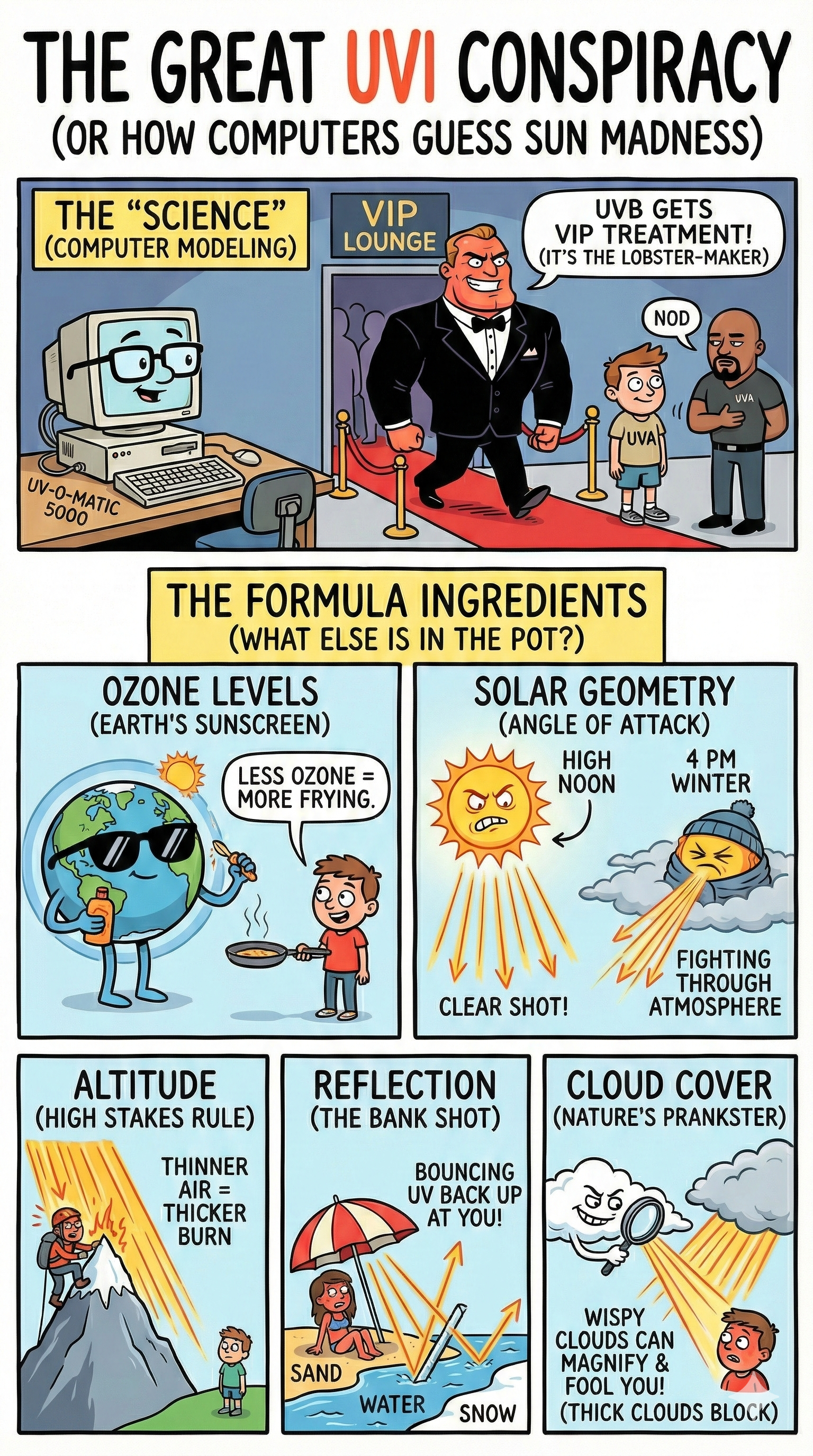
Most weather services don’t measure UV directly; they outsource the job to a computer model and call it science. Since UVB is far more likely to turn you into a lobster, these algorithms give it extra weight in the equation; while UVA gets a polite nod, UVB gets VIP treatment.
If you’re curious, here’s what else goes into the formula:
- Ozone levels: The Earth’s natural sunscreen. Less ozone = more frying.
- Solar geometry: The angle of attack. If the sun is directly overhead, it has a clear shot. If it’s 4 PM in winter, it has to fight through more atmosphere to get to you.
- Altitude: The “High Stakes” Rule. UV is stronger on mountains because there is less air to filter it out. (Thinner air = thicker burn).
- Reflection (The Bank Shot): Surfaces like snow, sand, and water act like mirrors, bouncing UV rays back up at you. This is how you get burned in the shade or under your chin.
- Cloud cover: Nature’s greatest prankster. Thick clouds block UV, yes, but wispy clouds can actually magnify it and fool you into thinking you’re safe until it’s too late.
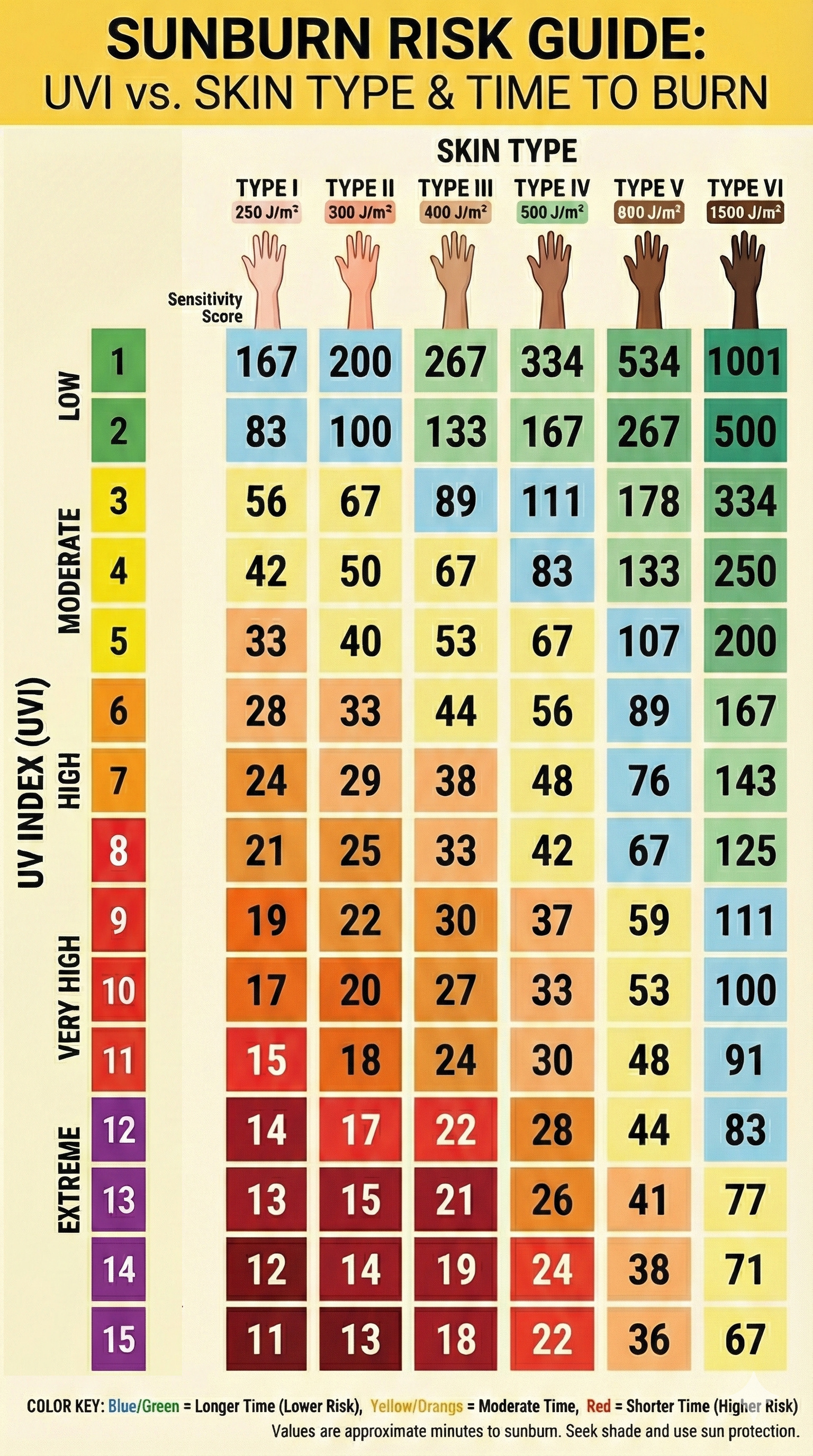
The table below combines the sun’s UV index with your skin type to estimate how many minutes you have before things start to sizzle.
NOTE: These times apply to untanned, unprotected skin. Please do not set a stopwatch and think, “Great, the chart says I have 17 minutes, so I will stand here for exactly 16 minutes and 59 seconds.” Your actual burn time also depends on your age, medications you’re taking, whether you’re sweating off or swimming, and many other factors. So treat these numbers as a warning, not a challenge.
END OF CHAPTER