

“My skin is so soft… Ow! Sunburn!”
~Homer Simpson, The Simpsons
We already covered sunburns in the first chapter but as a refresher, UVB is the main arsonist here, with UVA helping out by tossing in extra oxidative stress.
Once you reach or exceed your MED (Minimal Erythema Dose – that’s the UV dose required to make you slightly pink), your skin cells start releasing chemical messengers – prostaglandins and cytokines – which trigger an inflammatory response:
- Redness: The ambulance brigade (a surge of blood flow) arriving and double-parking at the burn site.
- Swelling: The fire hoses (fluid) turning on at full blast.
- Pain/sensitivity: Your nerves doing their job, making sure you are absolutely miserable so you don’t try this again anytime soon.
- Heat: Your skin now doubles as a personal heating appliance.
- Peeling (more serious burns): A few days later, your skin starts shedding like it’s trying to erase the evidence.
- System crash (severe burns): Blisters, fever, chills. You’ve officially upgraded to “Sun Poisoning.”
The burn site becomes an active construction zone where your immune system is frantically trying to clean up the mess you made and rebuild.
The illustration below summarizes just how much you’ve angered the sun, measured in multiples of MED.

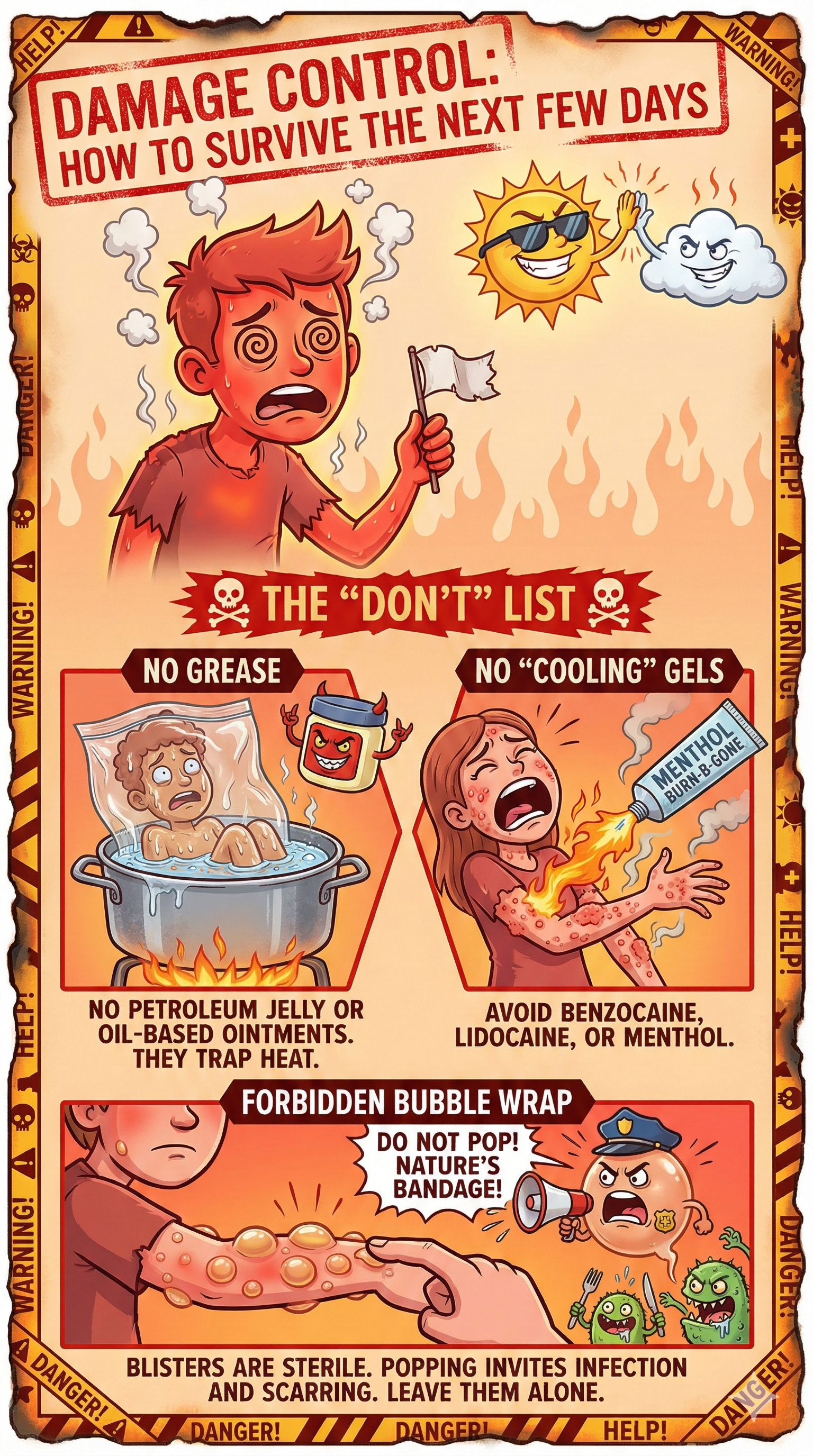
Damage Control: How to Survive the Next Few Days
So, you messed up. Here is how to soothe your skin without making it worse.
THE “DO” LIST
- Stop cooking: The most crucial step. Get out of the sun. Your defenses are down, any more sun is just kicking a man while he’s down.
- Cool it down: Use a damp, cold towel or take a cool shower. Do not use ice; putting ice on a burn causes “frostnip,” which is a fancy way of saying you gave yourself frostbite on top of a heat burn.
- Hydrate the skin: Use a gentle, fragrance-free moisturizer.
- Good options: Ceramide creams (CeraVe, Gold Bond), Snail Mucin, or Centella Asiatica.
- The aloe trap: Aloe is okay, but raw aloe has compounds that can irritate sensitive skin.
- Also, some store-bought green gels may be loaded with alcohol and preservatives that may sting like crazy. Read the label.
- Kill the pain: Ibuprofen, naproxen, or aspirin (NSAIDs) are your pain-relief cavalry. They reduce the swelling and the urge to cry.
- Manage the itch: The “Hell Phase” (itching) can be worse than the pain. Do not scratch; you may cause an infection. Use 1% hydrocortisone cream (sparingly on the face) to stop the madness.
- Drink water: Your burn is pulling fluid from the rest of your body to the skin surface. You are essentially a dried fruit right now. Drink water and electrolytes.
- Dress like a ghost: Wear loose, soft, breathable clothing. Friction is the enemy.

THE “DON’T” LIST
- No grease: Do not use petroleum jelly (Vaseline) or oil-based ointments. They trap heat, essentially “sous-vide cooking” your skin.
- No “cooling” gels: Avoid benzocaine, lidocaine, or menthol. They can trigger allergies and irritate damaged skin.
- Forbidden bubble wrap: Do NOT pop blisters. Blisters are nature’s sterile bandage. If you pop them, you invite infection and scarring. Leave them alone.
When You’ve Officially Gone Too Far
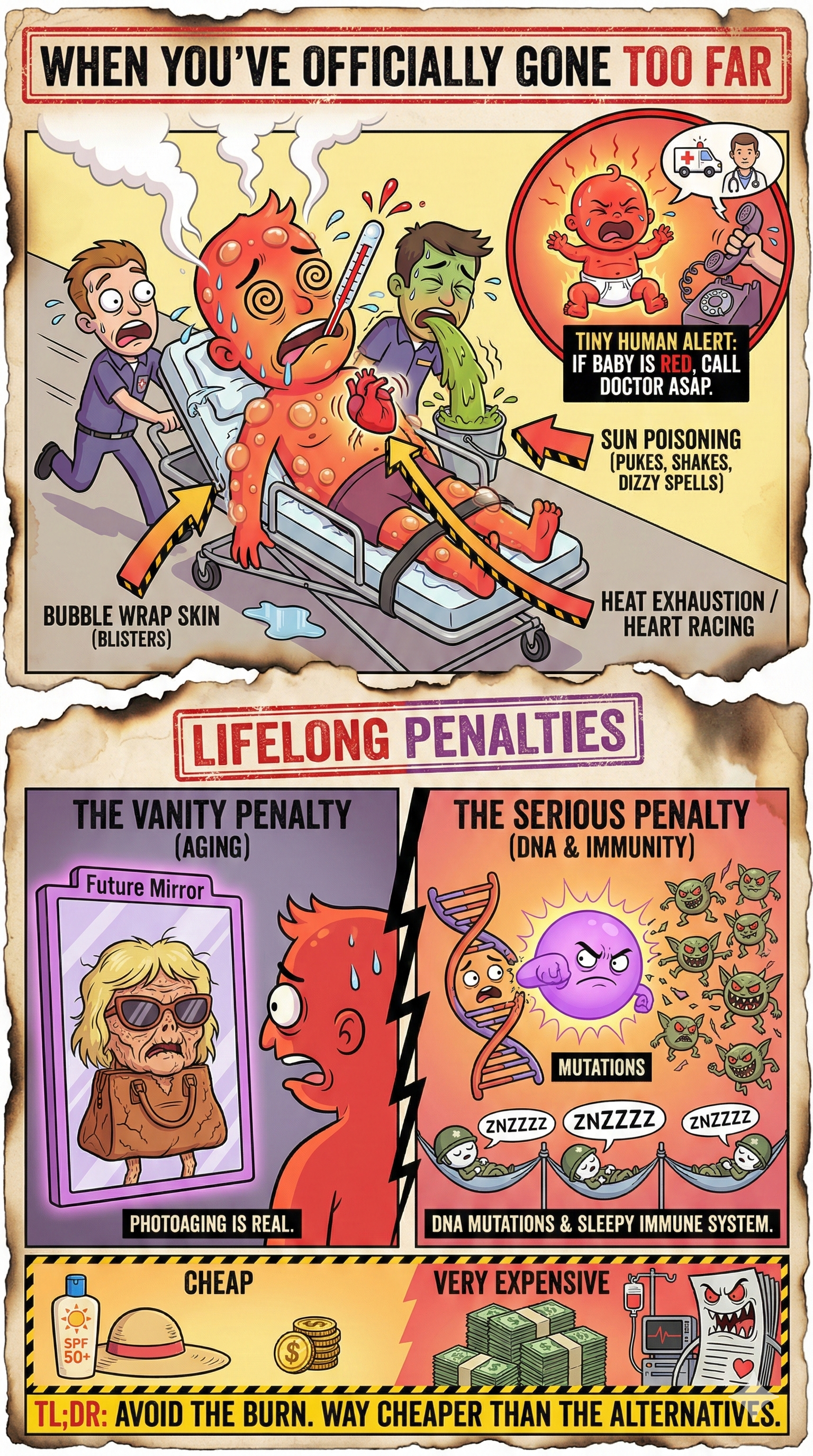
Sometimes, aloe and ibuprofen aren’t enough. Seek medical care immediately if you have:
- Large areas of blistering.
- Sun Poisoning: Fever, chills, nausea, dizziness, or fainting.
- Signs of infection (pus, spreading redness).
- Heat exhaustion: Rapid pulse, heavy sweating, clammy skin, or confusion.
- If a very young child gets a sunburn, call the doctor. Their skin is not ready for this nonsense.
The Receipt Comes Later: Long-Term Risks
Beyond the misery of this week, this sunburn carries a lifelong penalty.
- The vanity penalty: Repeated burns accelerate photoaging. If you love fine lines, leather-bag texture, and uneven spots, keep burning.
- The serious penalty: Every severe burn is a huge mutation event in your DNA. This accumulates over time, raising the risk of basal cell carcinoma, squamous cell carcinoma, and melanoma.
- The immune hit: Sunburn doesn’t just fry your skin; it also hits the “snooze” button on your local immune system, and over time that gives UV-damaged cells more room to misbehave.
TL;DR: One bad blistering burn in childhood can significantly increase your lifetime melanoma risk. Avoid UV overexposure and sunburns. It’s cheaper than the alternatives.
END OF CHAPTER