

“You shall not pass!”
~Gandalf, Lord of the Rings
When you plan to spend long hours outside, sunscreen is pretty much the only thing standing between you and sunburn, premature aging, or skin cancer. While the evidence for basal cell carcinoma protection is a bit wobbly, we can safely agree that “avoid all cancers” is a solid life strategy.
Of course, nothing in life is simple: some sunscreen ingredients show up with baggage, from potential hormone disruption to reef damage. So let’s unpack what’s in the bottle.
SPF: The “Sun Protection Factor”
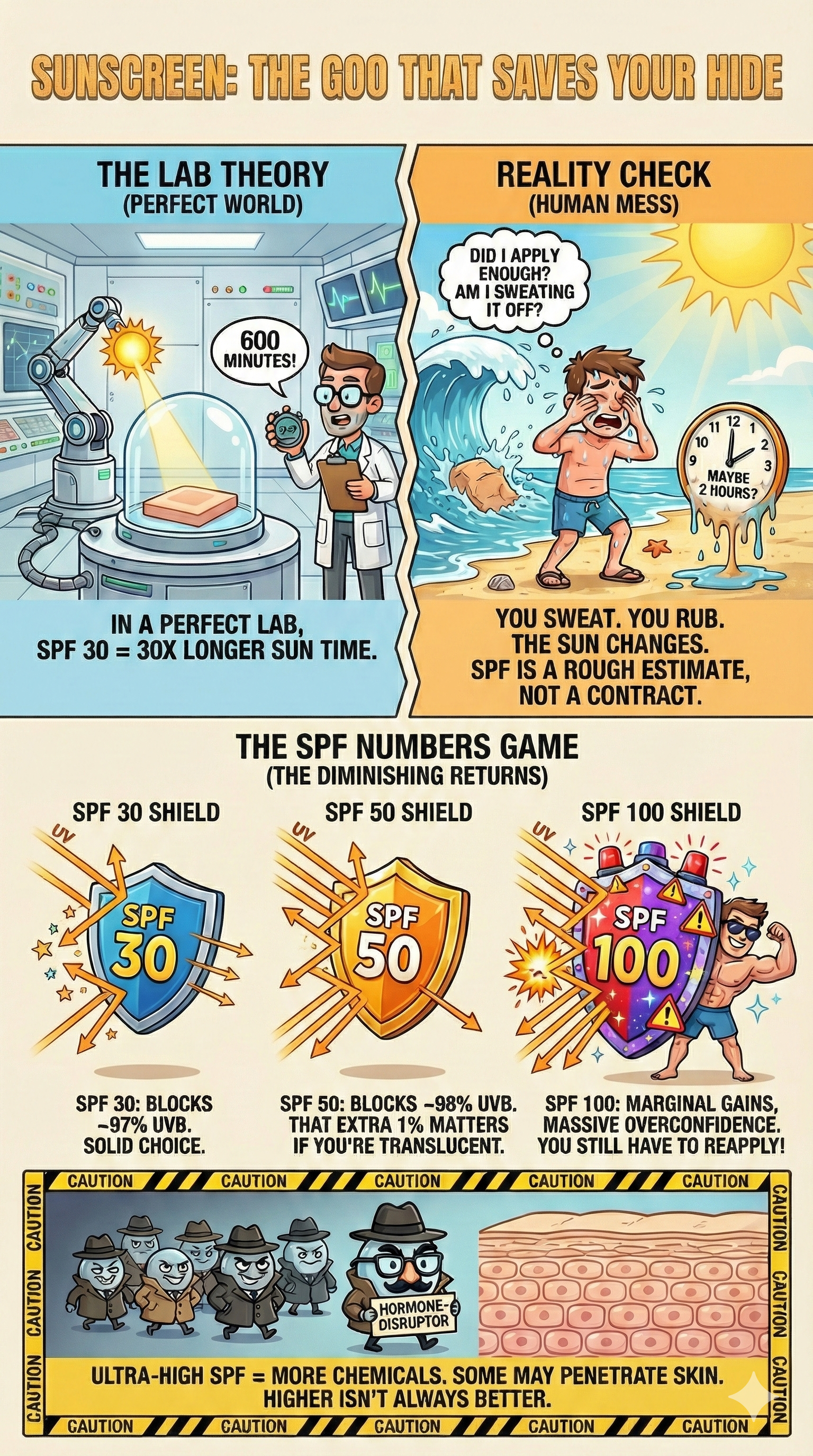
SPF is the number on the bottle that everyone trusts but almost nobody actually understands. It measures how much sunburn-causing UVB radiation gets through to your skin.
For instance, an SPF 30 blocks about 97% of UVB rays (that is, letting 1/30th through). An SPF 50 blocks about 98% (i.e., letting 1/50th through). You get the gist. That extra 1% from SPF 50 vs. SPF 30 may sound like nothing, but if you’re basically translucent, it matters.
Another way some think of SPF is as a time multiplier. In a perfect lab with robot-controlled sun, SPF 30 means you can stay out 30 times longer than normal: if your unprotected skin normally starts to burn after 20 minutes, SPF 30 on paper gives you 30 × 20 = 600 minutes.
But in reality, you sweat, you rub your face, the UV index changes, and almost nobody applies sunscreen correctly anyway. So treat it as a rough estimate, not a contract.
Another mistake people make – going above SPF 50 gets you only marginal gains but massive overconfidence. People slap on SPF 70 and assume they’re invincible all day. They are not. Higher SPF does not last longer; you still have to reapply.
The FDA actually tried to cap labels at “50+” because of this nonsense. You also hit diminishing returns: more chemicals for a tiny bump in UVB reduction. The Environmental Working Group (EWG) has warned that ultra-high SPF products may require higher concentrations of certain filters that can penetrate the skin, sometimes showing tissue damage and hormone-like effects in lab studies.
The Ingredients: Minerals vs. Chemicals
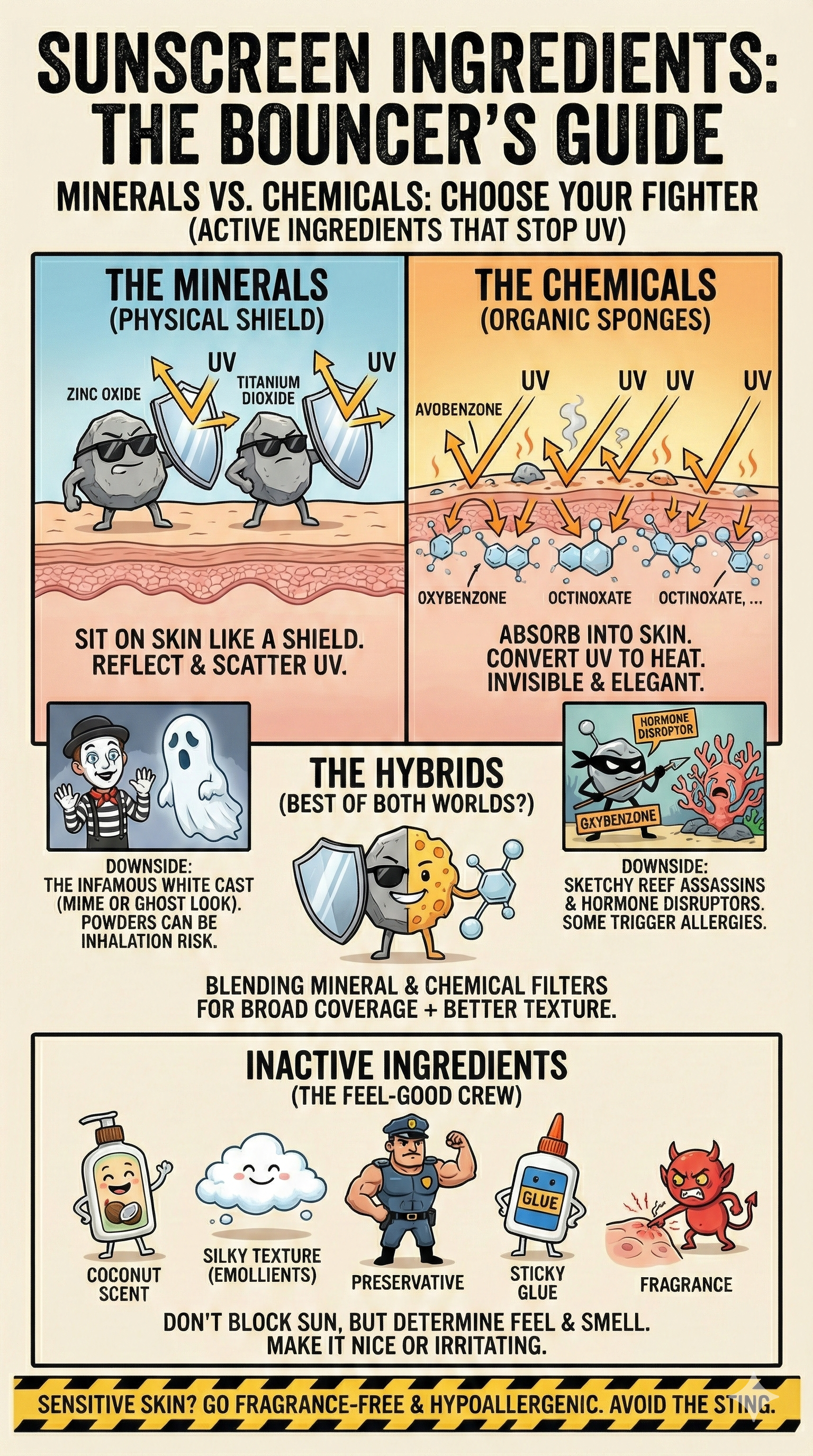
Active ingredients are the bouncers that stop UV rays at the door. They come in two families:
The Minerals (Physical Blockers)
- Players: Zinc oxide, titanium dioxide.
- How they work: They sit on top of your skin like a shield, mostly reflecting and scattering UV. They also absorb some UV and release it as heat.
- Vibe: Reliable, well-studied, and relatively reef-friendly. Great for babies, sensitive skin, and allergy-prone folks.
- Downside: The infamous white cast; you might look like a mime or a Victorian ghost. Tinted and micronized/nano formulations help, but spray or loose powder forms can be an inhalation concern (especially titanium dioxide).
The Chemicals (Organic Absorbers)
- Players: Avobenzone, oxybenzone, octinoxate, octocrylene, homosalate, and friends.
- How they work: They soak into the upper skin layers, absorb UV, and convert it into tiny amounts of heat.
- Vibe: Light, invisible, cosmetically elegant. These are the “doesn’t feel like sunscreen” sunscreens.
- Downside: Some are sketchy, and have been flagged by regulators as “needs more safety data”, aka “we’re not fully convinced yet.” Oxybenzone in particular is a repeat offender: it is a known hormone disruptor and coral reef assassin. Some are unstable in sunlight unless stabilized. Others trigger allergies.
The Hybrids
- A mix of both, blending mineral and chemical filters to get broad coverage + better texture. Best of both worlds? Usually.
Inactive Ingredients
These are the things that make the lotion feel nice (emulsifiers, emollients, preservatives, stabilizers, fragrances, texture enhancers). They don’t block sun, but they determine if the stuff smells like coconuts, feels like silky cloud or sticky glue, or burns your eyes and irritate your skin. If you have sensitive skin, go fragrance-free/hypoallergenic.
The Safety Scorecard: Who’s Safe and Who’s Sketchy?
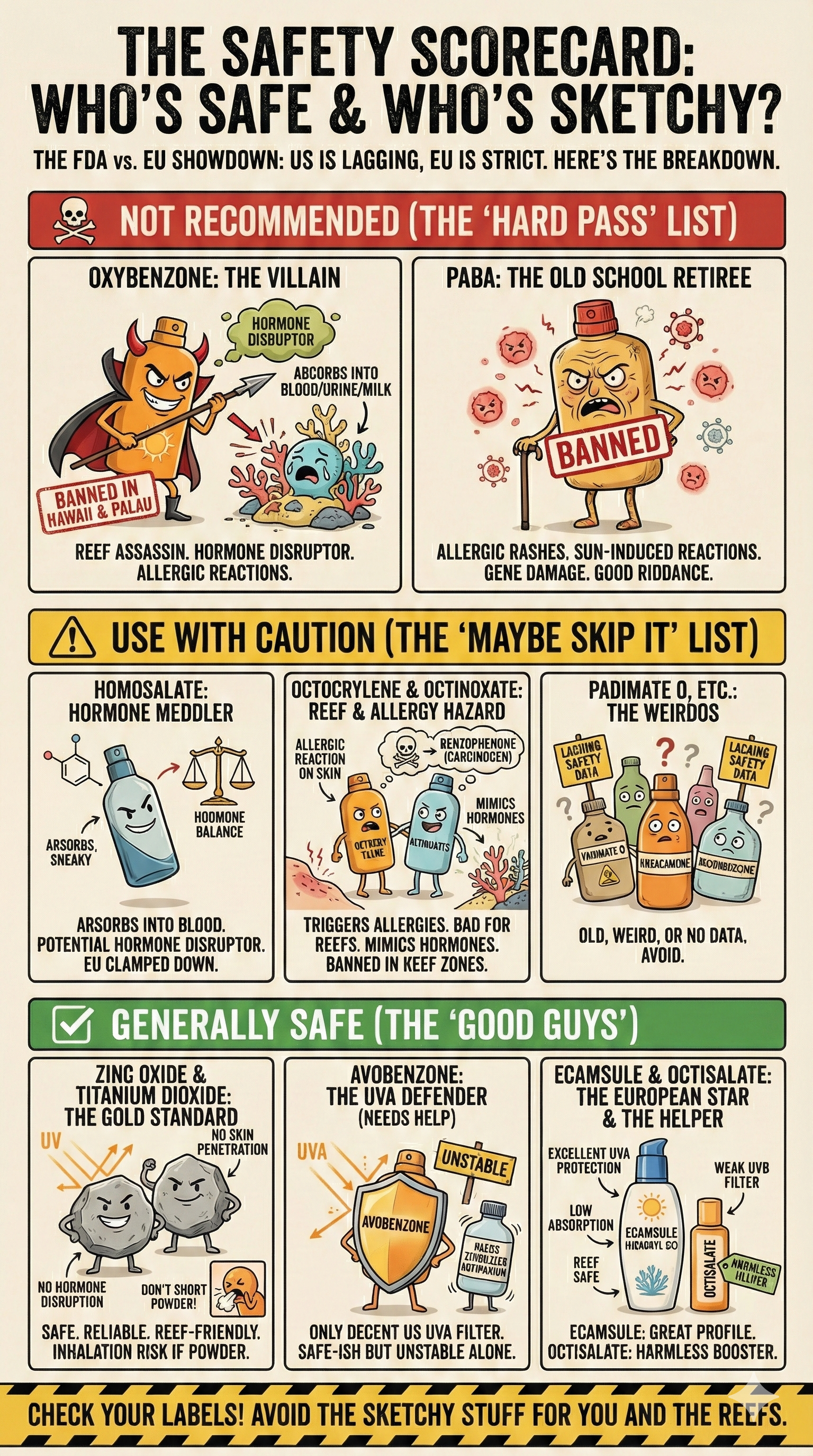
The FDA and EU monitor this stuff. The US is a bit behind (several older chemical filters are still technically allowed, but labeled “not GRASE” – not Generally Recognized as Safe and Effective – until more safety data arrives), while the EU is stricter – it allows more filter options but often at lower maximum concentrations and with stricter oversight. Here is the breakdown:
🚫 NOT RECOMMENDED (The “Hard Pass” List)
- Oxybenzone: The villain of the sunscreen world. Absorbs into blood/urine/breast milk, disrupts hormones, is linked to allergic reactions / photoallergy, and kills coral reefs. Banned in reef-protection laws in places like Hawaii and Palau.
- PABA: The old-school filter essentially retired for good reasons; caused allergic rashes, sun-induced reactions, free radical formation, possible gene damage. Good riddance.
⚠️ USE WITH CAUTION (The “Maybe Skip It” List)
- Homosalate: Absorbs into blood, potential hormone disruptor. Europe recently clamped down on how much can be used.
- Octocrylene: Widely used but triggers allergies and is bad for reefs. Can break down into benzophenone (a carcinogen).
- Octinoxate: Good UVB blocker, but mimics hormones and bleaches coral. Banned in reef zones.
- Padimate O / enzacamene / sulisobenzone: Old, weird, or lacking safety data. Not widely allowed in modern formulations.
✅ GENERALLY SAFE (The “Good Guys”)
- Zinc oxide & titanium dioxide: The gold standard for safety. No hormone disruption, no skin penetration (unless inhaled as powder; don’t snort your sunscreen).
- Avobenzone: The only decent UVA chemical filter in the US. Safe-ish, but unstable without help (needs stabilizers like octocrylene or other companions).
- Ecamsule (mexoryl SX): Excellent UVA protection, widely used in Europe/Asia. Very low skin absorption, no hormone concerns, and good environmental profile.
- Octisalate: Weak UVB filter, but harmless. Mostly there to help other ingredients.
If you want to fall down the ingredient rabbit hole, the EWG Sunscreen Guide is a good (if conservative) place to start:
https://www.ewg.org/sunscreen/about-the-sunscreens
Some dermatologists think they’re a bit alarmist, but if you’re ingredient-paranoid, they’re your people.
P.S. One sunscreen update worth mentioning: you won’t see this in the illustration above (will make sure to add it later), but it’s an important development. After decades of playing catch-up, the FDA has proposed adding bemotrizinol (a modern UV filter widely used in Europe and elsewhere) to the U.S. sunscreen lineup.
It provides strong UVA and UVB protection, stays stable in sunlight, and has a solid safety record abroad. If approved, it could mean better-performing sunscreens in the future without the “greased frying pan” or “ghostly lifeguard” aesthetic.
Here’s the link for more information: https://www.fda.gov/news-events/press-announcements/fda-proposes-expanding-sunscreen-active-ingredient-list
Don’t Kill the Reefs
When you swim, your sunscreen comes off and joins the ecosystem. In busy coastal areas this can create a chemical soup that some UV filters don’t play nicely in.
The “Toxic 3 O’s” (Oxybenzone, Octinoxate, Octocrylene) are banned in places like Hawaii, US Virgin Islands, Bonaire, Key West, and Palau.
If you care about the ocean (you do), go for:
- Mineral, non-nano zinc-based sunscreens where possible, and
- Sun-protective clothing (rash guards, long-sleeve swims, hats) when swimming near reefs.
Application: You Are Probably Doing It Wrong
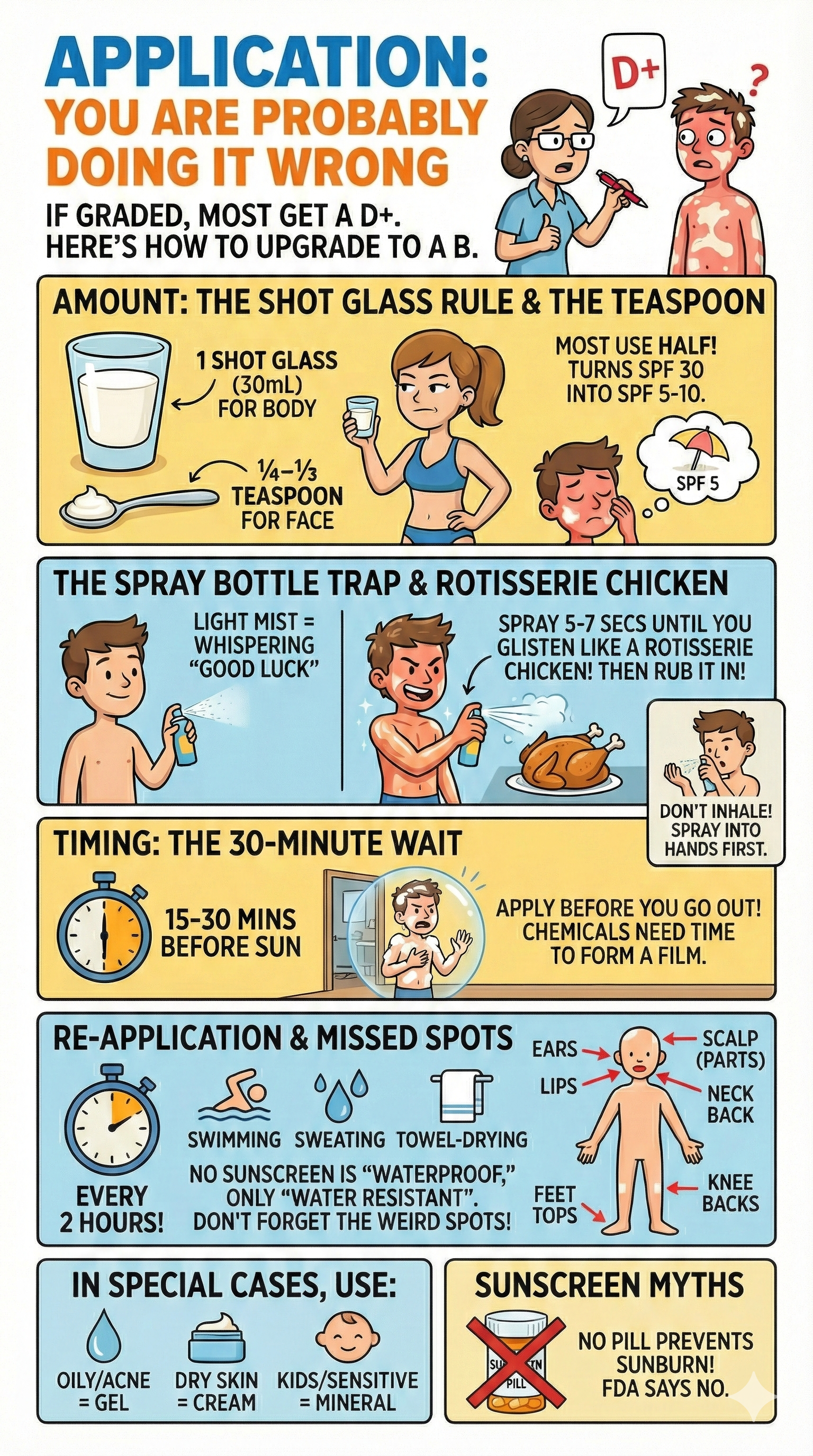
If sunscreen application were graded on technique, most people would be getting a generous D+. Here’s how to upgrade to at least a B.
Amount
For lotion-based sunscreens, you need ~2 mg/cm².
- For an adult in a swimsuit, that’s about 1 shot glass / 1 ounce / 30 mL for the whole body. Most people use half that, which turns SPF 30 into more like SPF 5–10.
- For the face alone, use roughly ¼–⅓ teaspoon.
Spray sunscreens are notoriously under-applied because a light mist feels like enough, but in reality it’s the UV-protection equivalent of whispering “good luck” to your skin.
- To get anywhere near the lab-tested amount, dermatologists recommend spraying each body area (arms, legs, torso, back) for 5–7 full seconds until your skin starts to glisten like a rotisserie chicken, then rubbing it in thoroughly so it actually forms a protective layer.
- For the face, don’t spray directly unless you enjoy inhaling your sunscreen; spray into your hands and apply by hand.
Timing
Timing: Apply 15–30 minutes before you go outside, especially for chemical filters that need time to form an even film. Don’t wait until you’re already sizzling on the beach.
Re-application
Reapply every 2 hours, and immediately after swimming, sweating a lot, or towel-drying. And no sunscreen is “waterproof,” only “water resistant” (for 40 or 80 minutes).
Missed spots: Ears, lips, scalp (part lines), back of neck, tops of feet, backs of knees. Don’t forget them.
Special cases
Dermatologists often suggest:
- Lightweight gels/fluids for oily/acne-prone skin.
- Creamier, more emollient formulas for dry skin.
- Mineral-based sunscreens for kids and sensitive skin
And while supplement companies love selling “sunscreen pills”, no pill has been proven to prevent sunburn, and the FDA does not allow those claims.
Antioxidant supplements may offer some background help, but they are not a substitute for sunscreen, shade, or clothing.
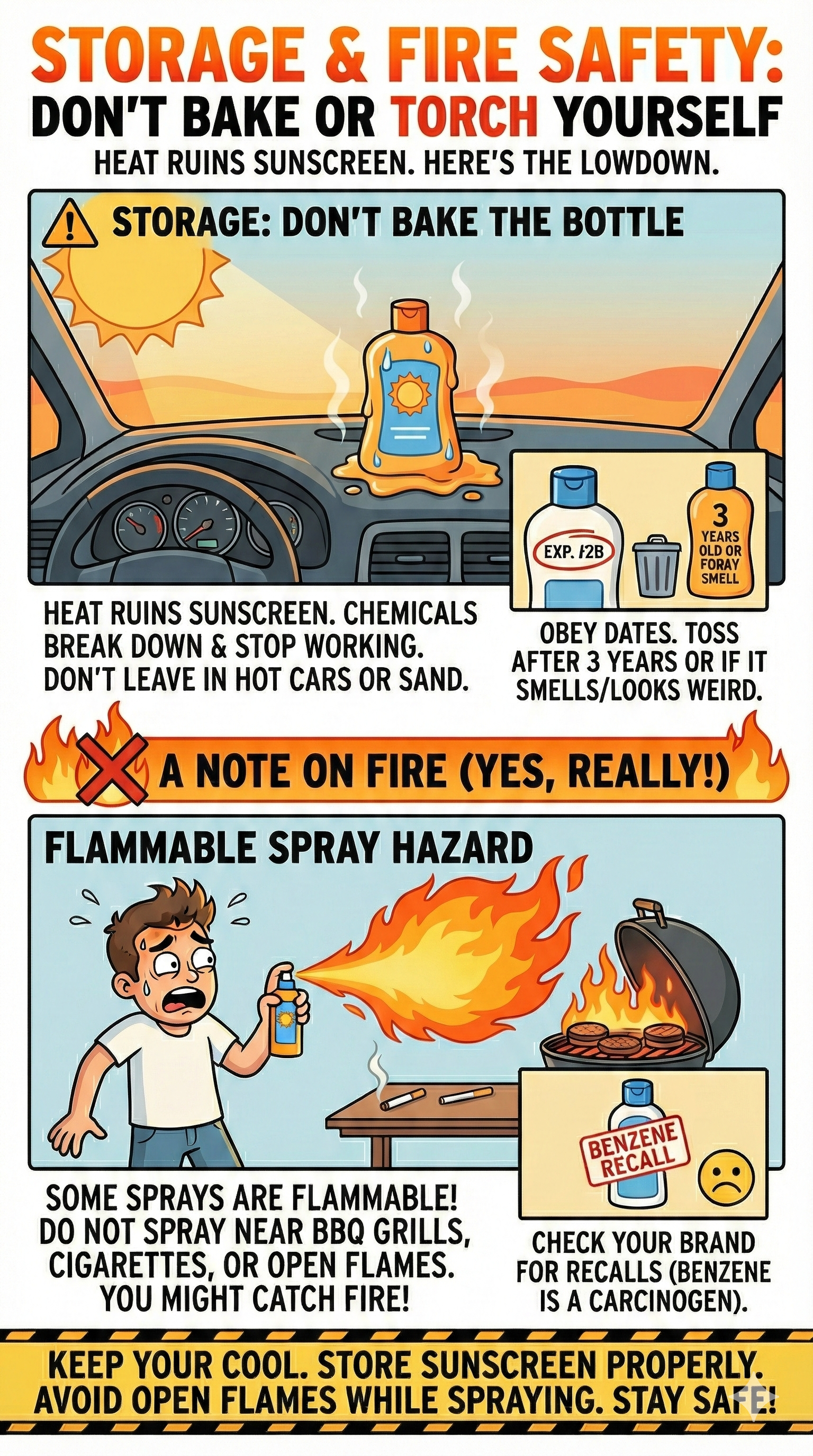
Storage: Don’t Bake the Bottle
Heat ruins sunscreen. If you leave the bottle in a hot car or baking in the sand, the chemicals break down and stop working.
If there is a date, obey it. If not, toss it 3 years after purchase. If it looks weird or smells funky, toss it immediately.
A Note on Fire (Yes, Really)
Some spray sunscreens contain alcohol and other flammable solvents. If you spray them while standing next to a BBQ grill or a lit cigarette, you might catch fire. This is not a joke. Flammable sprays have caused serious burns. Some sprays were recalled for containing Benzene (a carcinogen). Check your brand.
Tailor Your Strategy
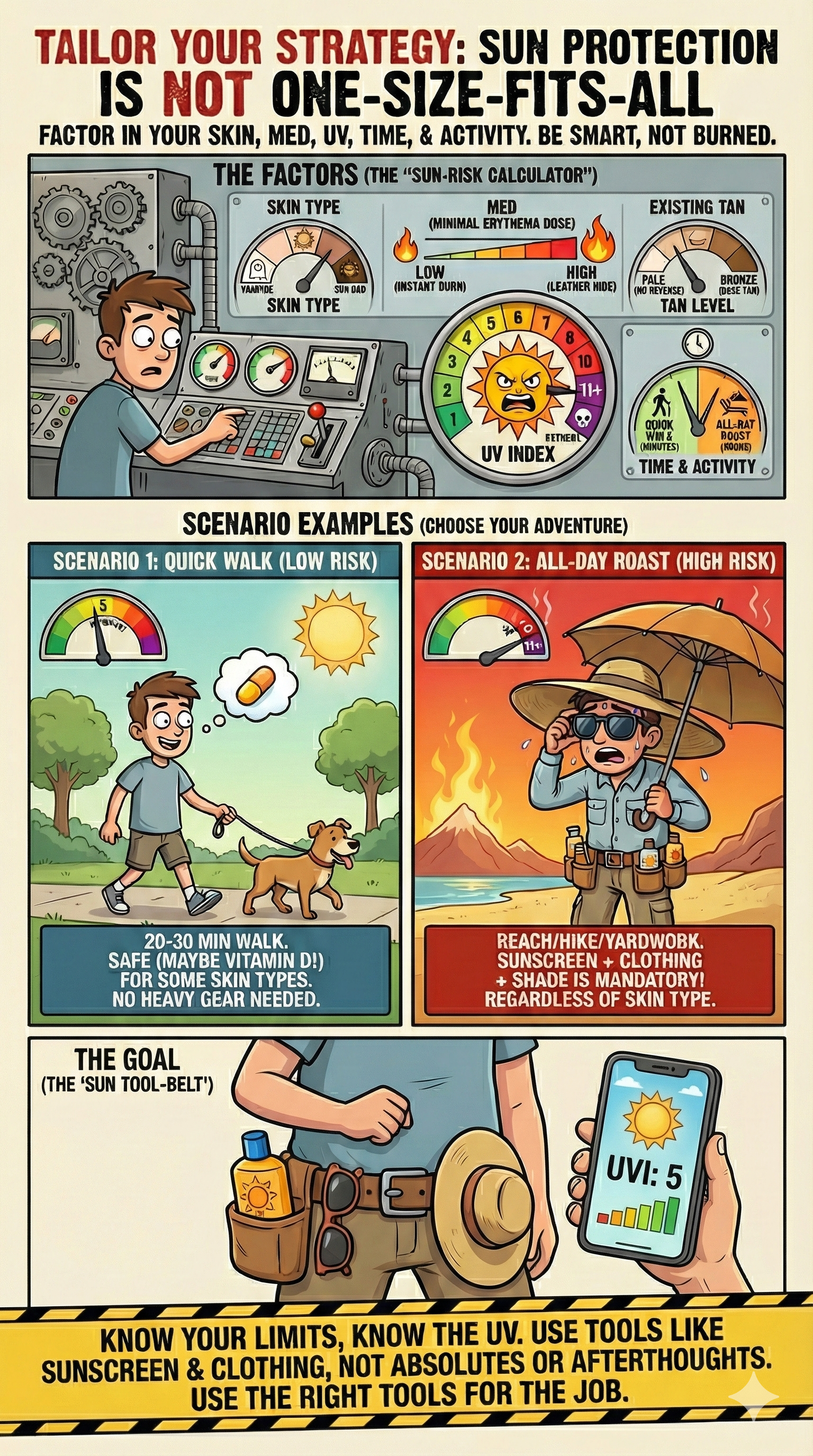
Sun protection isn’t one-size-fits-all. You should factor in your skin type, individual MED, existing tan, UV index, how long you’ll be outside, what you’re doing (quick walk or all-day roast), etc.
For example:
- A short 20–30 minute walk at UV Index 5 might be safe (and Vitamin D-friendly) for some skin types without sunscreen.
- A long beach day, mountain hike, or hours of yardwork? That’s sunscreen + clothing + shade territory, regardless of skin type.
- The goal isn’t “never see the sun again.” The goal is: Know your limits, know the UV, and use sunscreen and clothing like tools, not absolutes or afterthoughts.
Apps like Sola can help plan your day based on your individual traits and circumstances.
PS: Shameless promo? Absolutely.
END OF CHAPTER