

“Pay no attention to that man behind the curtain!”
~The Wizard of Oz
We live in an age of instant gratification. We want Amazon Prime shipping, 5-minute abs, and a tan that doesn’t require suffering. This demand has birthed an entire industry of lotions, potions, pills, and needles promising a golden glow without the UV damage.
Some work. Some are placebo. Some are straight-up dangerous. Let’s cut through the hype, marketing sparkle, and questionable influencers.
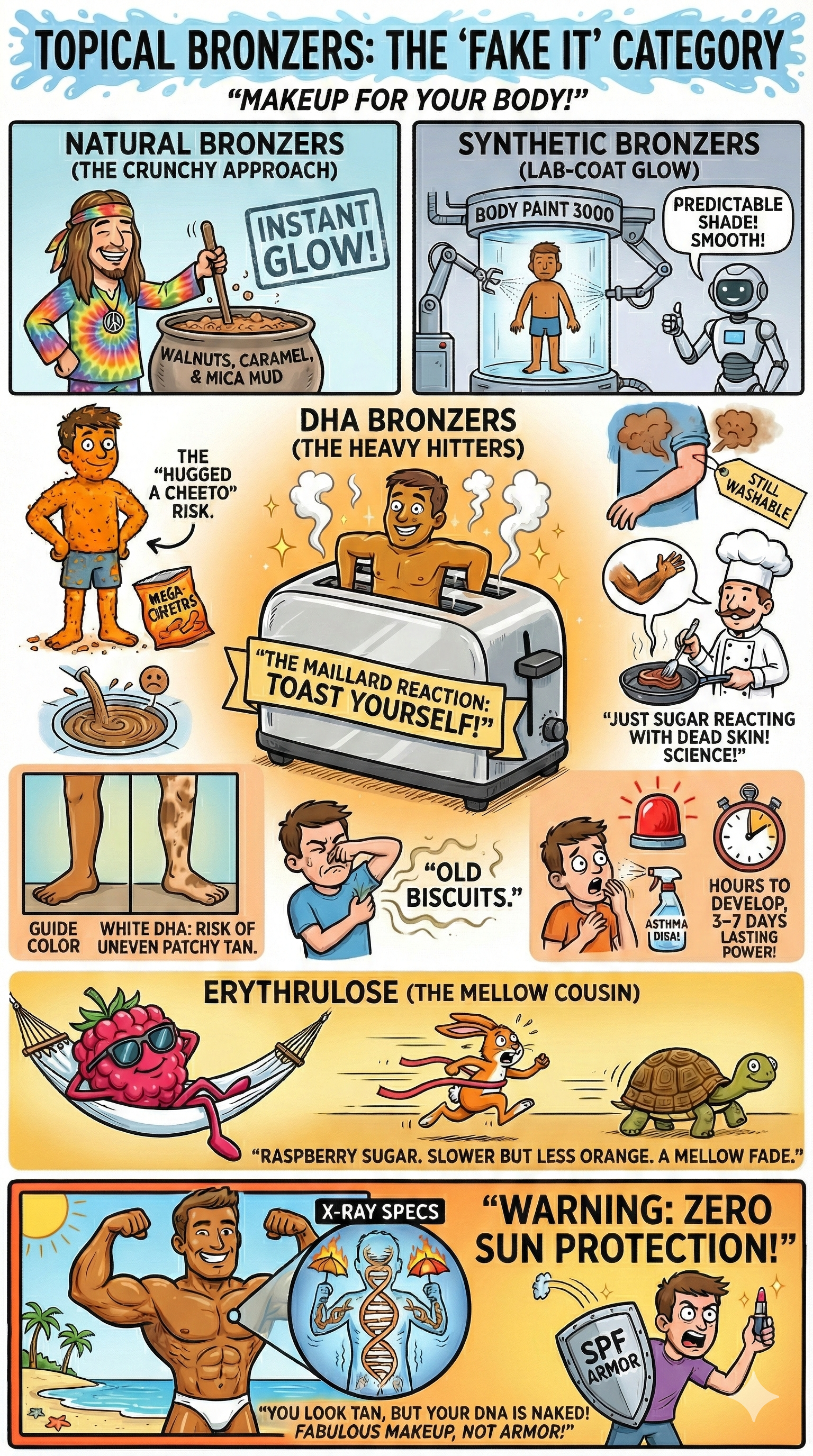
Topical Bronzers (The “Fake It” Category)
Bronzers are essentially makeup for your entire body. They don’t boost melanin; they simply stain the surface.
They come as lotions, gels, sprays, mousses, wipes, powders, basically everything except breakfast cereal (give it time).
Natural Bronzers
Made from caramel, henna, walnut shell, and minerals like mica and iron oxides.
Pros: Instant glow, generally safe.
Cons: Wash off fast, can trigger plant allergies in sensitive folks, and sometimes make you look like you hugged a bag of Cheetos.
Synthetic Bronzers
Lab-made pigment versions of the above. Think “high-tech body paint.”
Pros: Instant glow, more predictable shade, smoother finish.
Cons: Still wash off, may irritate sensitive skin.
DHA Bronzers: The Heavy Hitters
The “Self-Tanner” standard. DHA (dihydroxyacetone) is a sugar that reacts with amino acids in your dead skin cells (the Maillard reaction) to turn them brown. Yes, it is literally the same browning reaction that happens when you toast bread or sear a steak. You are browning yourself.
Most DHA self-tanners include a pigment “guide color” so you can see exactly where you’ve painted yourself. “White” DHA formulas skip the tint: less mess, yes, but they also make it easier to miss a spot and end up developing a patchy, abstract-art tan.
Pros: Lasts 3-7 days. Water-resistant.
Cons: Takes hours to develop. Can smell like old biscuits. Spraying it in your lungs is a bad idea (asthma risk). Also, DHA makes your skin more sensitive to free radical damage for 24 hours, so don’t apply it and immediately roast in the sun.
Erythrulose (The Raspberry Sugar)
The mellow cousin of DHA, often mixed with DHA to improve tone and fade.
Pros: Less orange, fades more evenly.
Cons: Takes 2-3 days to show up. Still offers no real sun protection, and increases free radicals a bit under UV light.
Bottom line: bronzers are a safe, effective option for a sunless tan, but remember they provide ZERO sun protection. You look tan, but your DNA is still naked. Treat them like makeup: fabulous, fun, but not armor.
Accelerators, Tinglers, & Other Marketing Buzzwords
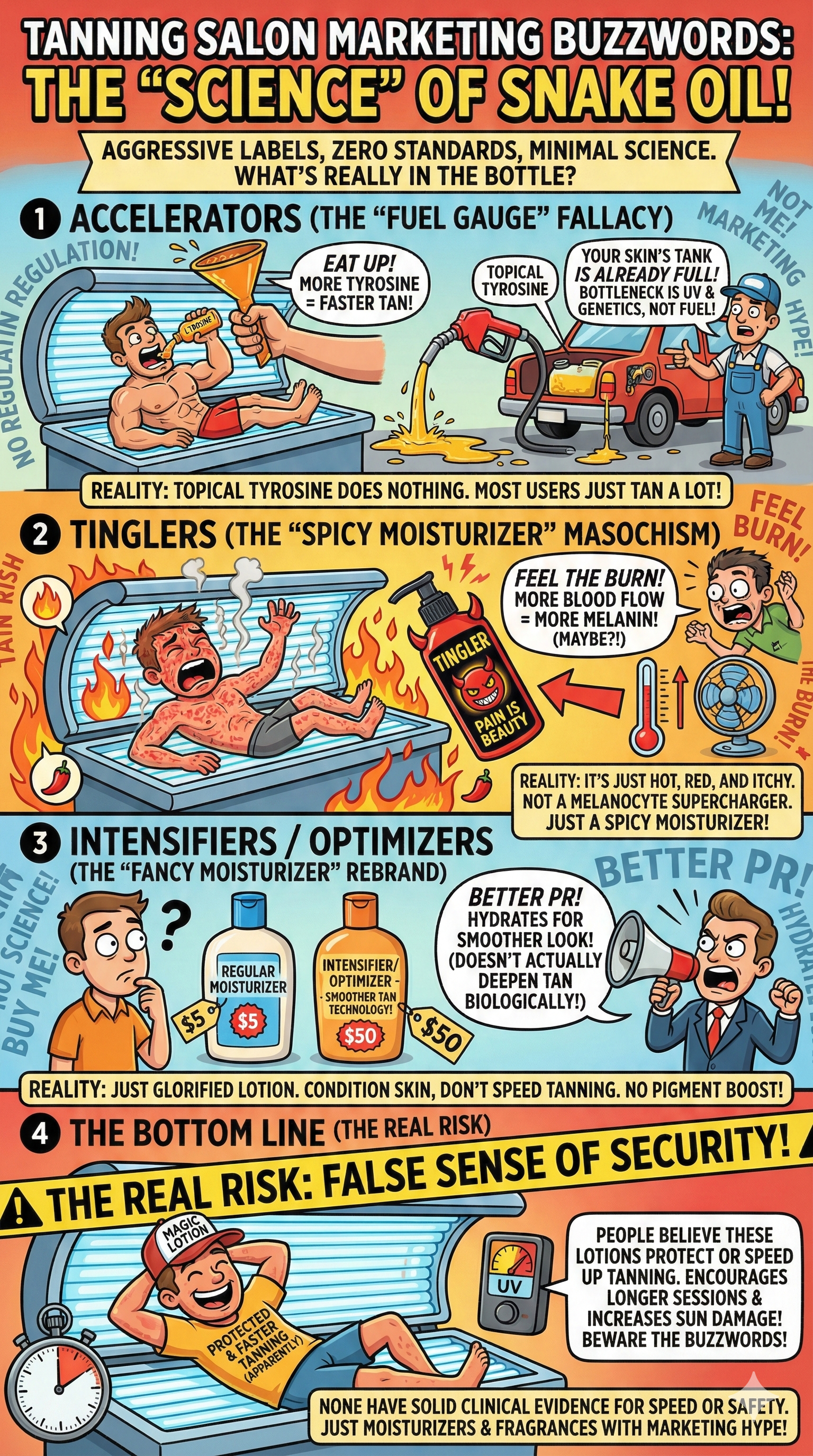
Walk into a tanning salon, and you’ll see bottles labeled with aggressive words like “Accelerator,” “Maximizer,” and “Explosion.” Nothing is standardized, regulated, or backed by meaningful science. So what do they actually do?
Accelerators
Claim: “We feed your skin L-Tyrosine so it makes melanin faster!”
Reality: Your skin already has plenty of tyrosine. Adding more on top is like pouring gas on a car that already has a full tank. The bottleneck isn’t the fuel; it’s UV amount and your skin type.
Most frequent accelerator users just tan a lot, that’s why they are darker, not because the lotion is magic. And studies repeatedly show topical tyrosine does nothing to increase tanning.
Tinglers (The “Pain is Beauty” Lotions)
Contain vasodilators like benzyl or methyl nicotinate to make your skin feel warm, tingly, and slightly panicked.
Claim: “More blood flow = more melanin!”
Reality: More blood flow = more redness, more irritation, and the illusion that “something is happening” but mostly, you’re simply hot and itchy.
They’re spicy moisturizers, not melanocyte superchargers.
Intensifiers / Optimizers
Basically fancy moisturizers with better PR. They may help your tan look smoother by hydrating the skin but do not deepen the tan biologically.
Intensifiers are accelerators without pigment; they condition skin, not tanning speed.
Optimizers add moisturizers/antioxidants for smoother tans, but don’t create more pigment.
All of these products – accelerators, intensifiers, optimizers, tinglers – are variations on tanning lotions. Most contain moisturizers, fragrances, and sometimes small amounts of tyrosine or plant extracts.
They may make tanning feel more indulgent and keep skin hydrated, but none of them have solid clinical evidence of actually speeding up tanning or making it safer. The real risk is that people believe these lotions protect them or let them tan faster, which can encourage longer sessions and increase sun damage.
Melanocortin Peptides
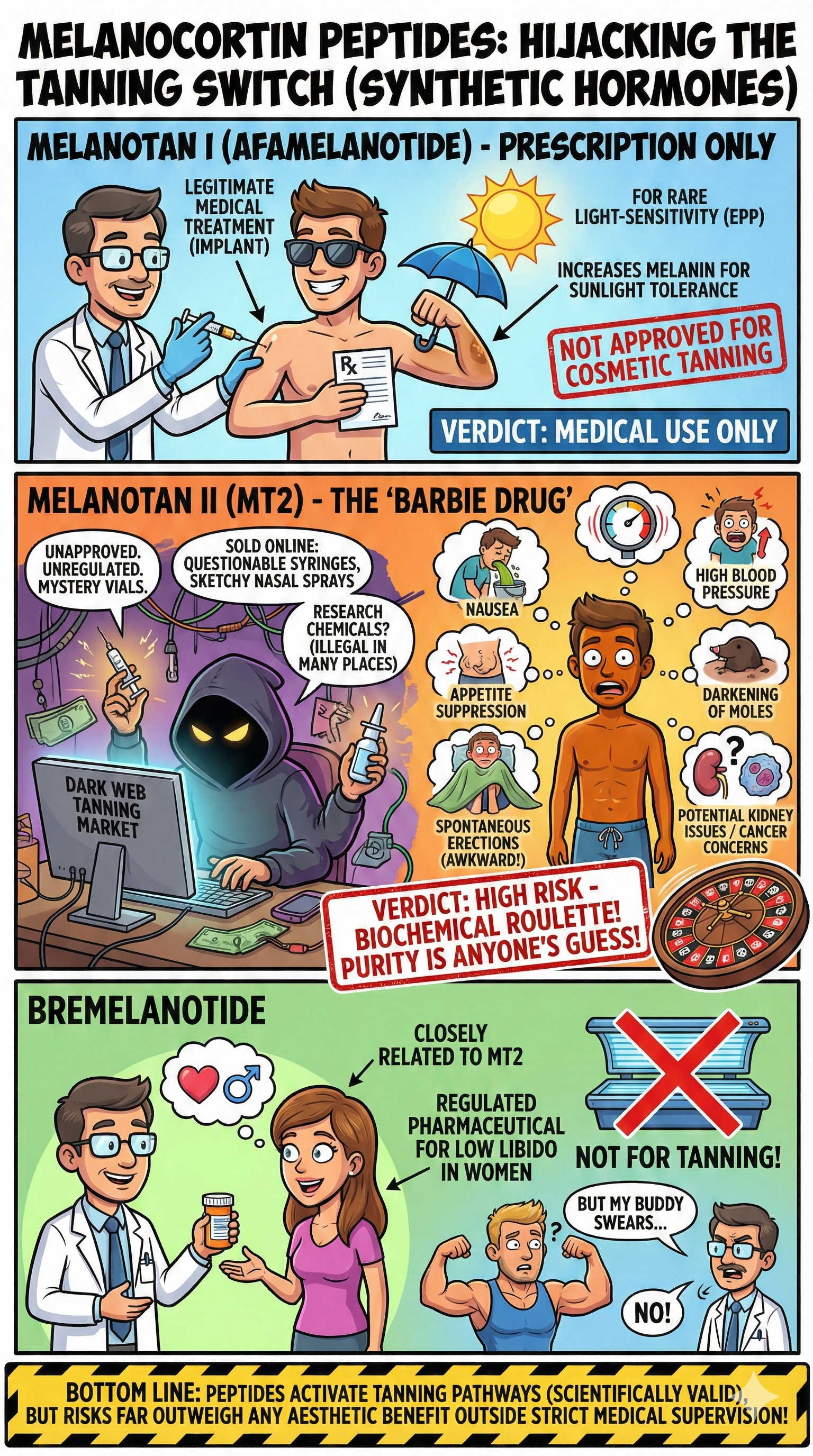
These are synthetic hormones that hijack your body’s tanning switch.
Melanotan I (Afamelanotide)
A legitimate medical treatment, a prescription drug (implant) for people with rare light-sensitivity diseases (EPP). It increases melanin to help patients tolerate sunlight. Not approved for cosmetic tanning.
Melanotan II (The “Barbie Drug”, a.k.a. MT2)
The dark web’s favorite “tanning injection.” Unapproved. Unregulated. Sold online in questionable syringes, sketchy nasal sprays, or mysterious “research chemicals.” Illegal in many places.
Triggers rapid, deep tanning with zero sun, but with many side effects: nausea, high blood pressure, appetite suppression, spontaneous erections (awkward), darkening of moles, potential kidney issues, and concerns about cancer in some case reports.
Verdict: High risk. Injecting unregulated mystery vials from the internet is generally a bad life strategy. And purity is anyone’s guess. Using this stuff is basically playing biochemical roulette.
Bremelanotide
Closely related to Melanotan II, a regulated pharmaceutical for treating low libido in women. Not for tanning, even if your gym buddy swears otherwise.
Bottom line: These peptides do activate tanning pathways, so scientifically valid. But outside strict medical supervision, their risks far outweigh any aesthetic benefit.
Oral Supplements (Tanning from the Inside)
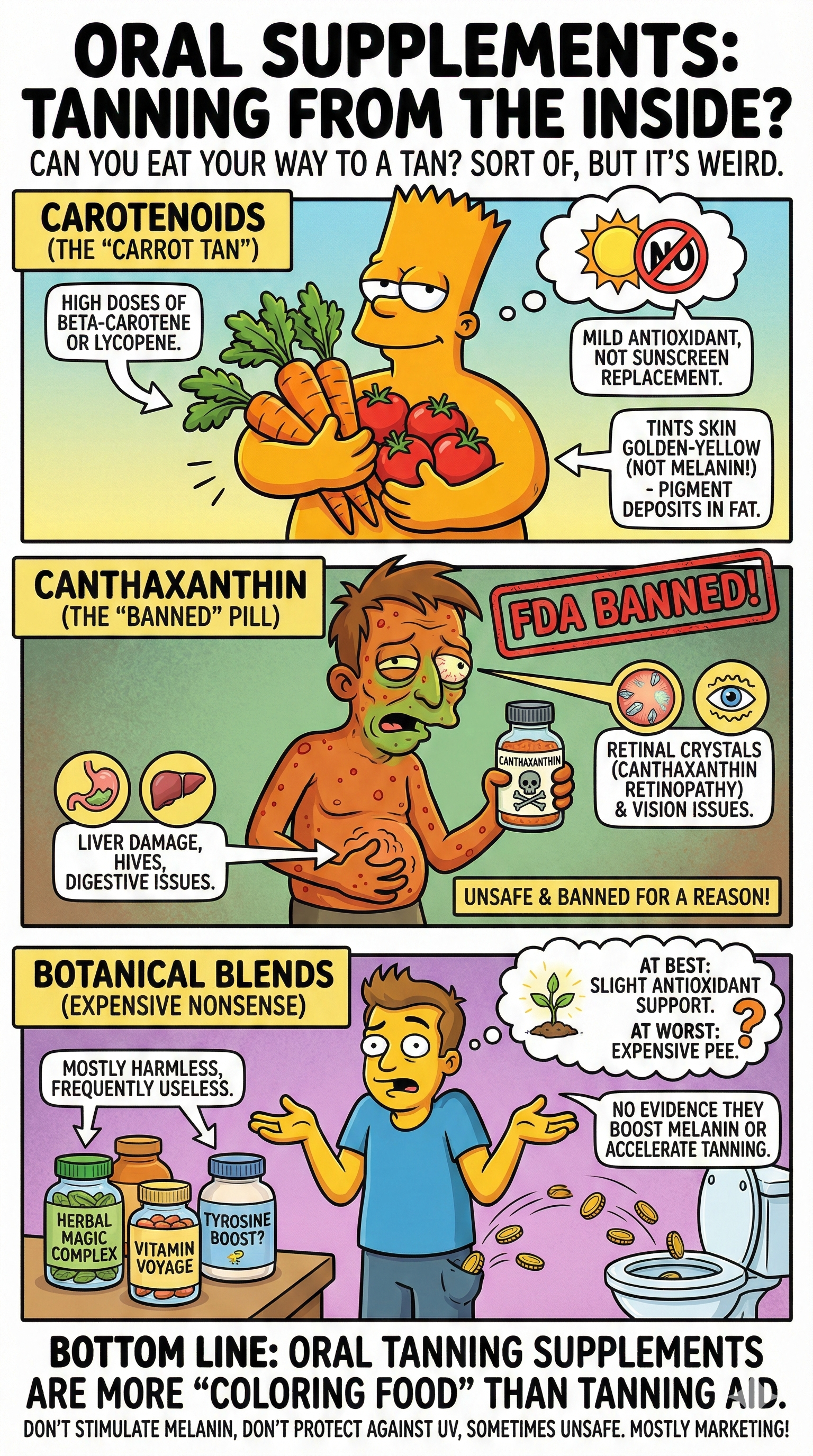
Can you eat your way to a tan? Sort of, but it’s weird.
Carotenoids (The “Carrot Tan”)
High doses of beta-carotene or lycopene can tint your skin golden-yellow, sort of like a Simpson. It’s not melanin; it’s literally pigment depositing in your fat. They may offer mild antioxidant protection but do not replace sunscreen.
Canthaxanthin (The “Banned” Pill)
A synthetic pigment that turns you rust-orange. Besides side effects like liver damage, hives, and digestive issues, it deposits crystals in your retina (canthaxanthin retinopathy). It can mess up your vision and liver. The FDA banned it for a reason.
Botanical Blends
Mostly harmless, frequently useless. Contain herbs, oils, vitamins, and tyrosine “complexes.” No clinical evidence they boost melanin or accelerate tanning. At best: slight antioxidant support. At worst: expensive nonsense.
Bottom line: Oral tanning supplements are more “coloring food” than tanning aid. They don’t stimulate melanin, don’t protect against UV, and sometimes aren’t safe. Mostly marketing with a side of expensive pee.
END OF CHAPTER