

“Life is pain, Highness. Anyone who says differently is selling something.”
~Westley, The Princess Bride
Sometimes your skin is glowing and cooperative; other times, it can be moody, opinionated, and quite dramatic. Understanding why your skin reacts to heat and UV helps you manage its mood swings without ruining your vacation. Here’s a few tips on how to decode what it’s trying to tell you.
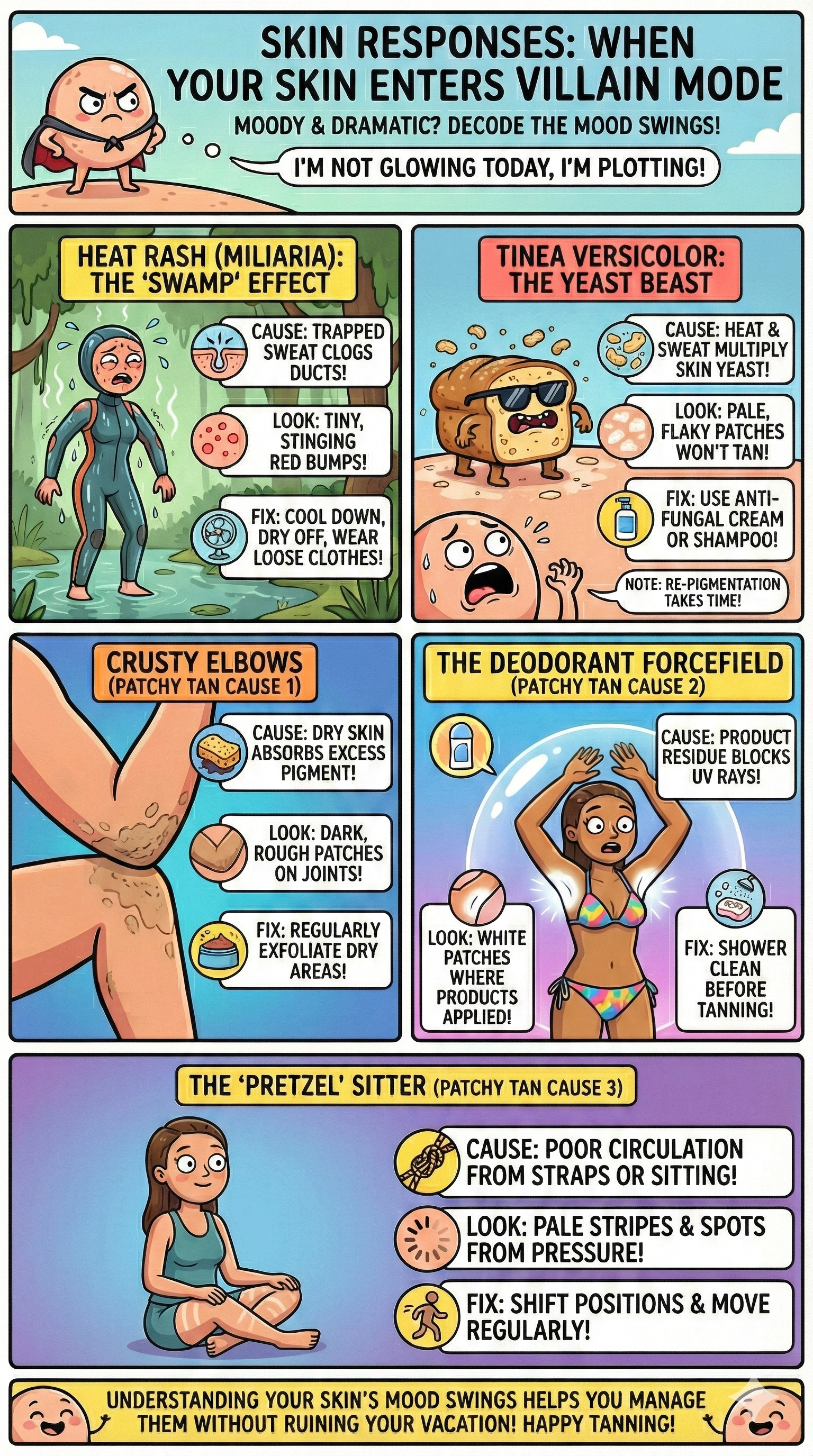
Heat Rash (Miliaria): The “Swamp” Effect
Cause: You spent too long sweating in tight clothes. Your sweat ducts got claustrophobic, clogged up, and decided to riot.
Look: Tiny, stinging red bumps, usually in places that don’t get enough air (under straps, waistbands, or back).
Fix: Stop marinating in your own juices. Cool down, dry off, wear clothes that breathe, and avoid heavy, oily lotions that trap heat.
Tinea Versicolor: The Yeast Beast
Cause: Everyone has yeast living on their skin. (No, you are not secretly a loaf of bread.) Normally it minds its own business. But heat and sweat can make this yeast multiply aggressively. It creates an acidic byproduct that bleaches your pigment.
Look: Pale, flaky patches that refuse to tan. It looks like you peeled badly, but it’s actually a fungus blocking the melanin party.
Fix: Anti-dandruff shampoo (selenium sulfide) or a topical anti-fungal cream usually kills it.
Note: The white spots won’t tan instantly; you have to wait for the skin to shed and re-pigment.
Other Causes of a Patchy Tan
Uneven tanning is the bane of every perfectionist, influencer, and anyone who has ever wanted to look like one smooth gradient instead of a topographical heat map. Here is why you look blotchy:
Crusty Elbows
Cause: Dry skin is like a thirsty sponge, it grabs onto pigment with the enthusiasm of someone discovering self-tanner for the first time.
Look: Your elbows and knees end up three shades darker than everything else, as if they went on a separate vacation.
Fix: Exfoliate and moisturize your knees and elbows unless you want them to come in different editions.
The Deodorant Forcefield
Cause: Deodorant, leftover sunscreen, perfumes, and body oils can form invisible UV “no-go zones” on your skin.
Look: If your armpits are glowing white while the rest of you is caramelized, congratulations: you’ve created a personal anti-tan forcefield. On the bright side, at least it’s symmetrical. Usually.
Fix: Clean your skin before tanning, especially areas where products tend to linger. Or embrace the look and tell people it’s avant-garde body contouring.
The “Pretzel” Sitter
Cause: Crossing your legs, squeezing into tight straps, or sitting like a pretzel cuts off blood flow and oxygen (melanin’s favorite coworkers).
Look: You get mysterious pale stripes and spots, like your tan is buffering in low resolution.
Fix: Uncross, un-crunch, and shift positions regularly. Think “restless toddler,” not “human paperclip.”
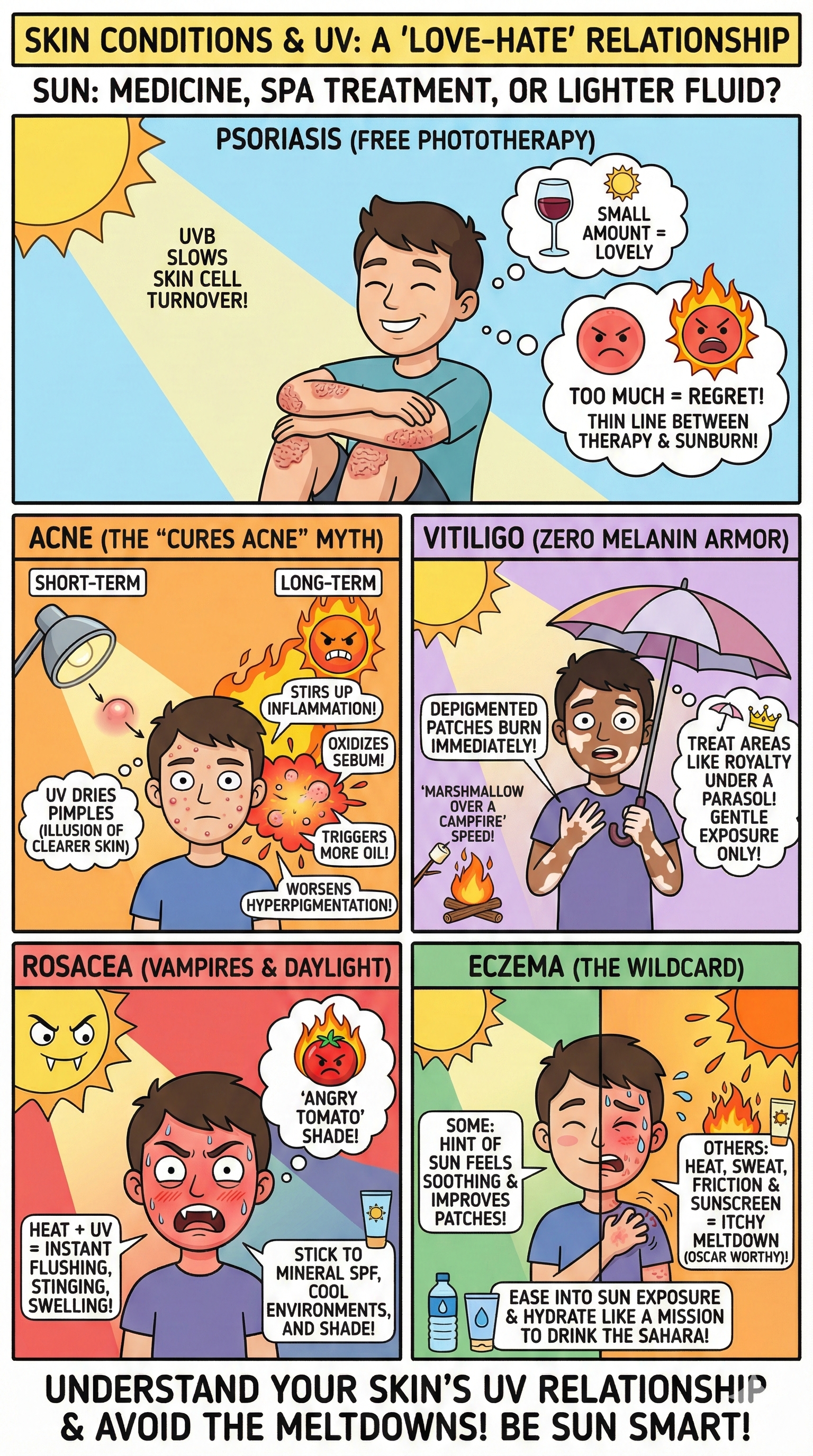
Skin Conditions & UV: A “Love-Hate” Relationship
For some conditions, the sun is medicine or a spa treatment. For others, it’s lighter fluid.
Psoriasis
The sun is basically free phototherapy for many people with psoriasis; UVB slows down that overachieving skin cell turnover and can smooth plaques beautifully.
But there’s a catch: the line between “therapeutic dose” and “oops, now it’s a sunburn” is very thin.
Think of UV like wine: a small amount = lovely; too much = regret the next morning.
Acne
Ah yes, the classic “Sun cures acne” myth.
Short-term: Yes, UV can dry out pimples and give the illusion of clearer skin.
Long-term: Likely no, UV stirs up inflammation, oxidizes sebum, worsens hyperpigmentation, and may trigger even more oil production.
Vitiligo
In controlled medical settings, UV can coax melanocytes back into action. But in real-life sunlight?
Those depigmented white patches have zero melanin armor, so they burn approximately immediately. Think “marshmallow over a campfire” speed.
Gentle exposure may help, but sunburn is the sworn enemy of vitiligo; treat those areas like royalty under a parasol.
Rosacea
Rosacea and the sun have the same relationship as vampires and daylight: absolutely not.
Heat + UV = instant flushing, stinging, swelling, and a facial shade best described as “angry tomato.” Even mild morning sun can set it off.
Stick to mineral SPF, cool environments, and the shade: your skin will thank you with fewer meltdowns and flare-ups.
Eczema (Atopic Dermatitis)
Eczema is the wildcard. For some people, a hint of sun feels soothing and improves patches. For others, the combination of heat, sweat, friction, and sunscreen can ignite an itchy meltdown worthy of an Oscar.
If you have eczema, ease into sun exposure slowly and hydrate like your skin is on a mission to drink the Sahara.
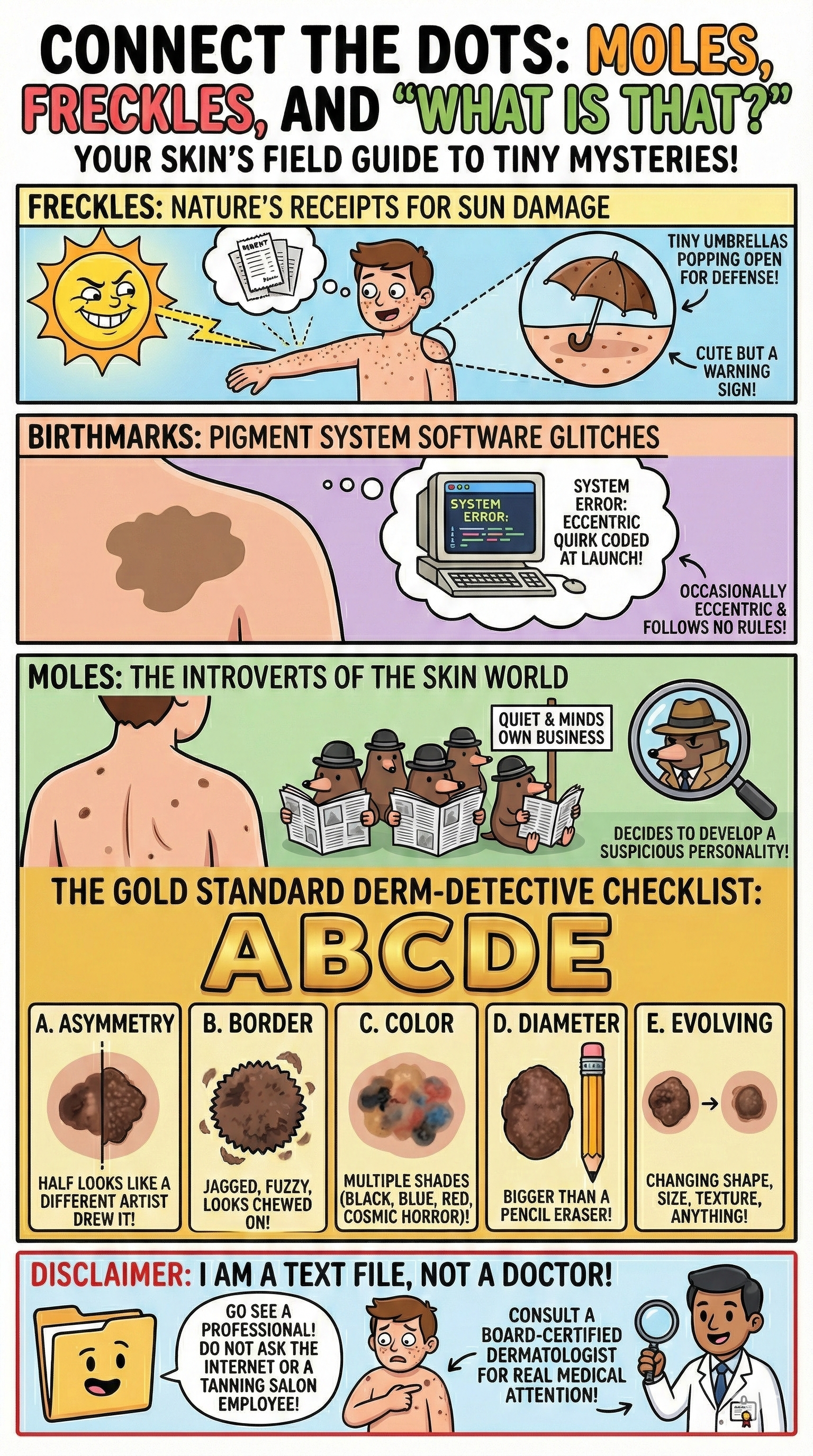
Connect the Dots: Moles, Freckles, and “What is That?”
Freckles
Freckles are basically nature’s receipts for sun damage. They are cute, but they are technically your skin trying to defend itself with tiny umbrellas of melanin, popping open every time you stay in the sun longer than your skin thinks was reasonable.
Birthmarks
Birthmarks are the software glitches of your pigment system; tiny cosmetic quirks coded into you at launch.
Usually harmless, occasionally eccentric. Some darken in the sun, some don’t, some seem to have no rules at all.
Moles
Moles are the introverts of the skin world: most of them stay quiet and mind their own business for decades. But every now and then one decides to develop a personality and start acting suspicious.
That’s when you break out the ABCDE checklist, the gold standard of derm-detective work:
A. Asymmetry: One half looks like it was drawn by a totally different artist.
B. Border: The edges are jagged, fuzzy, or look like they’ve been chewed on.
C. Color: Suddenly showing multiple shades (black, blue, red, cosmic horror).
D. Diameter: It’s bigger than a pencil eraser.
E. Evolving: It’s changing shape, size, texture, marital status, anything.
Disclaimer: I Am A Text File, Not A Doctor
If your skin is doing something weird, painful, or rapidly changing, go see a professional. Do not ask the internet, and do not ask a tanning salon employee.
A Board-Certified Dermatologist is the only person qualified to tell you whether that spot is a harmless freckle, a fungus with ambition, a rash with poor timing, or something that needs real medical attention.
END OF CHAPTER