

“I did not see that coming.”
~Loki, Thor: Ragnarok
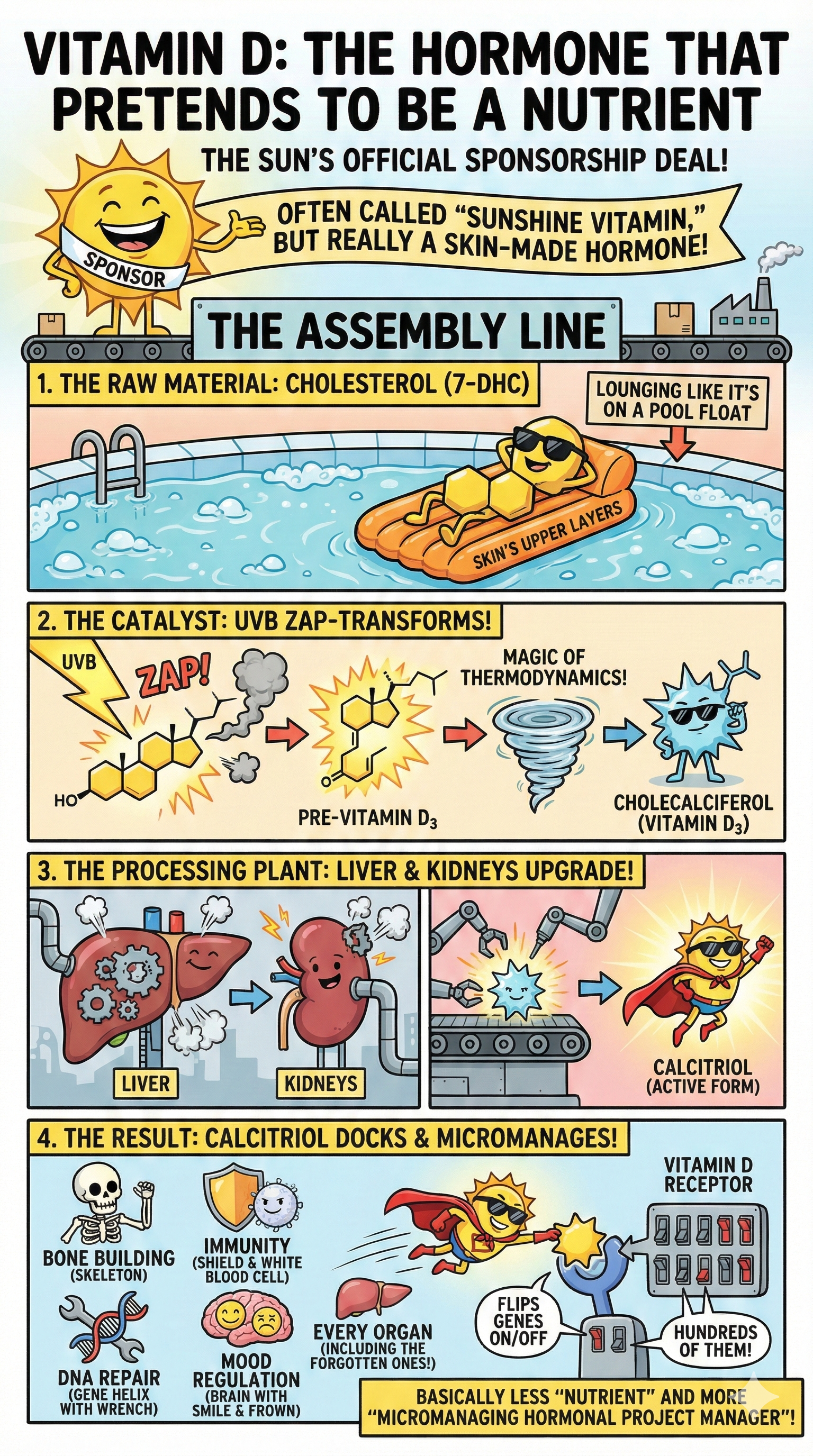
If humans had a sponsorship deal with the sun, vitamin D would be the official featured product. It’s often called the “sunshine vitamin,” but really it’s a hormone your skin makes under UVB rays.
The Assembly Line
- The raw material: A cholesterol compound (7-DHC) lounges in your skin’s upper layers like it’s on a pool float.
- The catalyst: UVB zap-transforms 7-DHC into pre-vitamin D₃, which then (through the magic of thermodynamics) turns into cholecalciferol (vitamin D₃)
- The processing plant: Your liver and kidneys finish the job, upgrading it into calcitriol, the active form.
- The result: Calcitriol docks with vitamin D receptors (found in nearly every organ you own, including the ones you forget exist). It flips genes on and off (hundreds of them) governing immunity, bone building, DNA repair, mood regulation… basically vitamin D is less “nutrient” and more “micromanaging hormonal project manager.”
The Dosage: How Much Sun Before You’re Good?
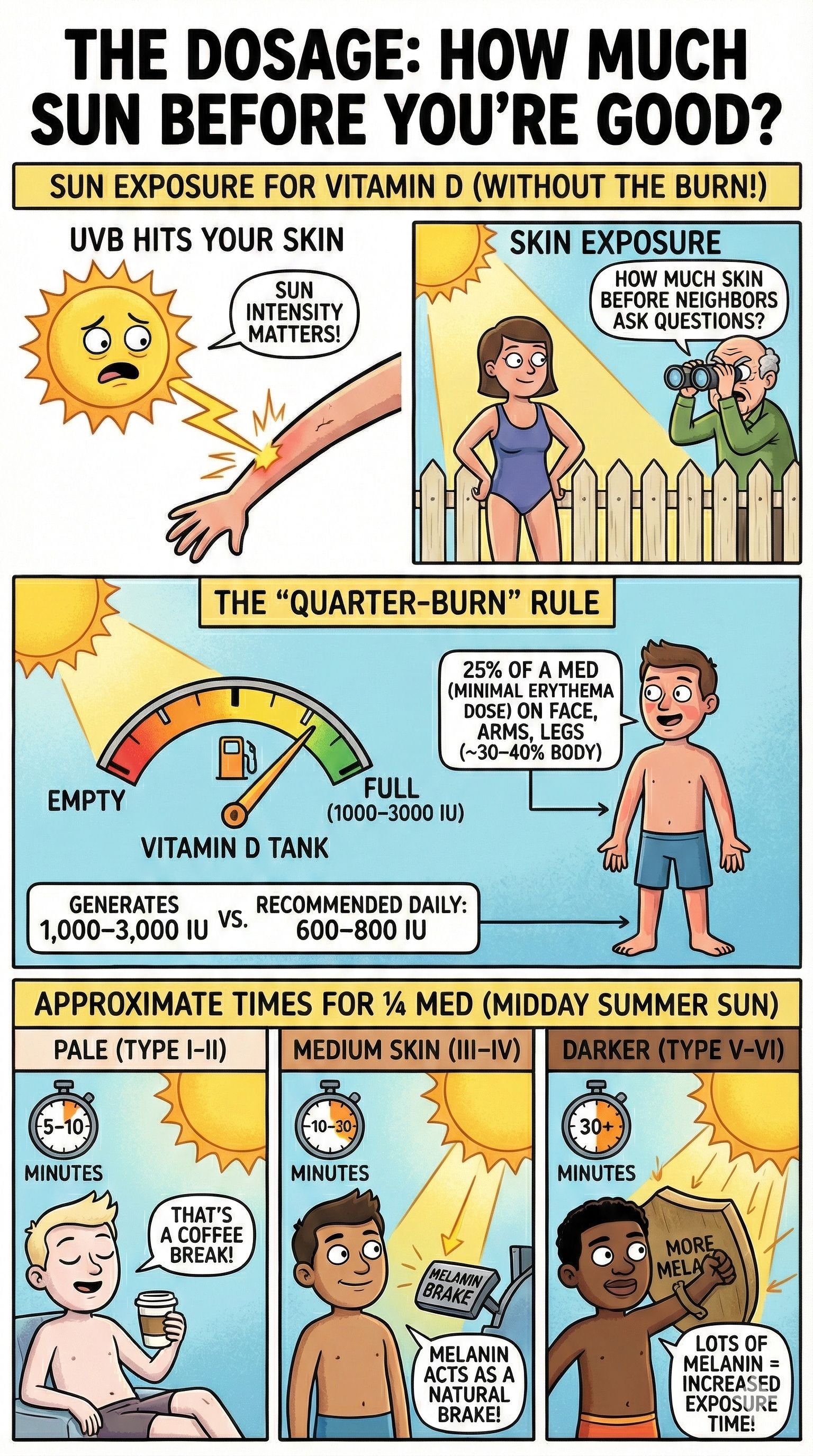
You do not need to bake for hours to fill your tank. In fact, your skin is surprisingly efficient. Vitamin D production depends on two main things:
- How much UVB hits your skin, and
- How much skin you’re willing to expose before the neighbors start asking questions.
The “Quarter-Burn” Rule
You only need about 25% of a MED on your face, arms, and legs (about 30–40% of your body) to generate 1,000–3,000 IU of Vitamin D. That is way more than the recommended daily intake of 600–800 IU.
Approximate times for that ¼ MED dose at midday in summer:
- Pale (Type I-II): We are talking 5–10 minutes of midday sun. That’s a coffee break.
- Medium skin (III–IV): Melanin starts to act as a natural brake on production, so you might need ~10–20 minutes.
- Darker (Type VI-V): Lots of melanin so your exposure time may increase to 30+ minutes.
The Storage: Your Body is a Hoarder
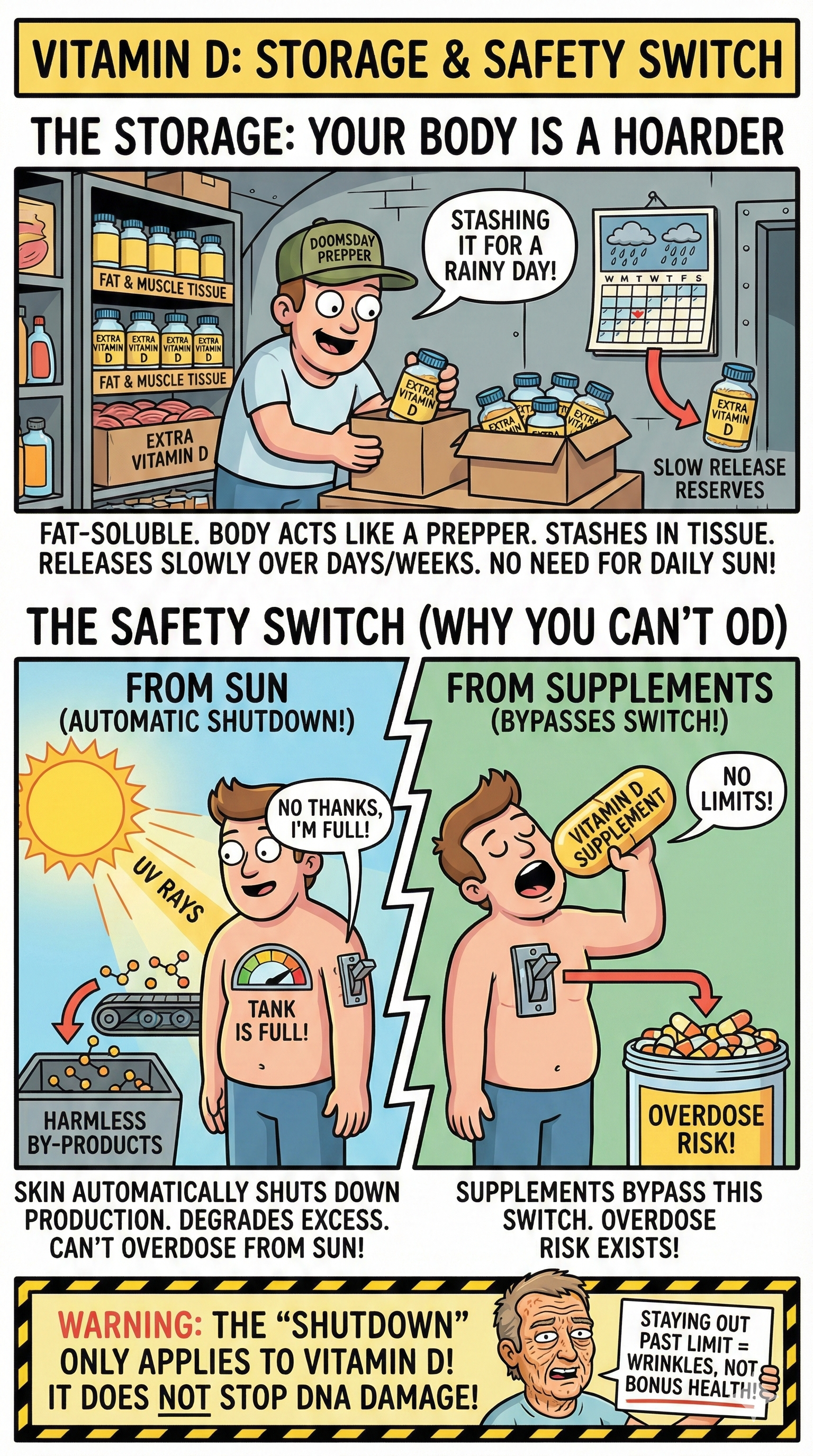
Vitamin D is fat-soluble, which means your body acts like a Doomsday Prepper. It stashes extra Vitamin D in your fat and muscle tissue for a rainy day (literally), releasing it slowly over days or weeks. You don’t need sun every single day to stay healthy; your pantry reserves have you covered.
The Safety Switch (Why You Can’t OD)
Here is a cool design feature: You cannot overdose on Vitamin D from the sun. Once your tank is full, your skin automatically shuts down production and degrades the excess into harmless by-products (the biological equivalent of a “No thanks, I’m full.”)
Supplements don’t have this safety switch: you can overdose because they bypass this safety switch.
The “shutdown” only applies to Vitamin D. It does not stop DNA damage. So, staying out past your limit doesn’t give you “extra bonus health”; it just gives you wrinkles.
Why You Need It (The Benefits Package)
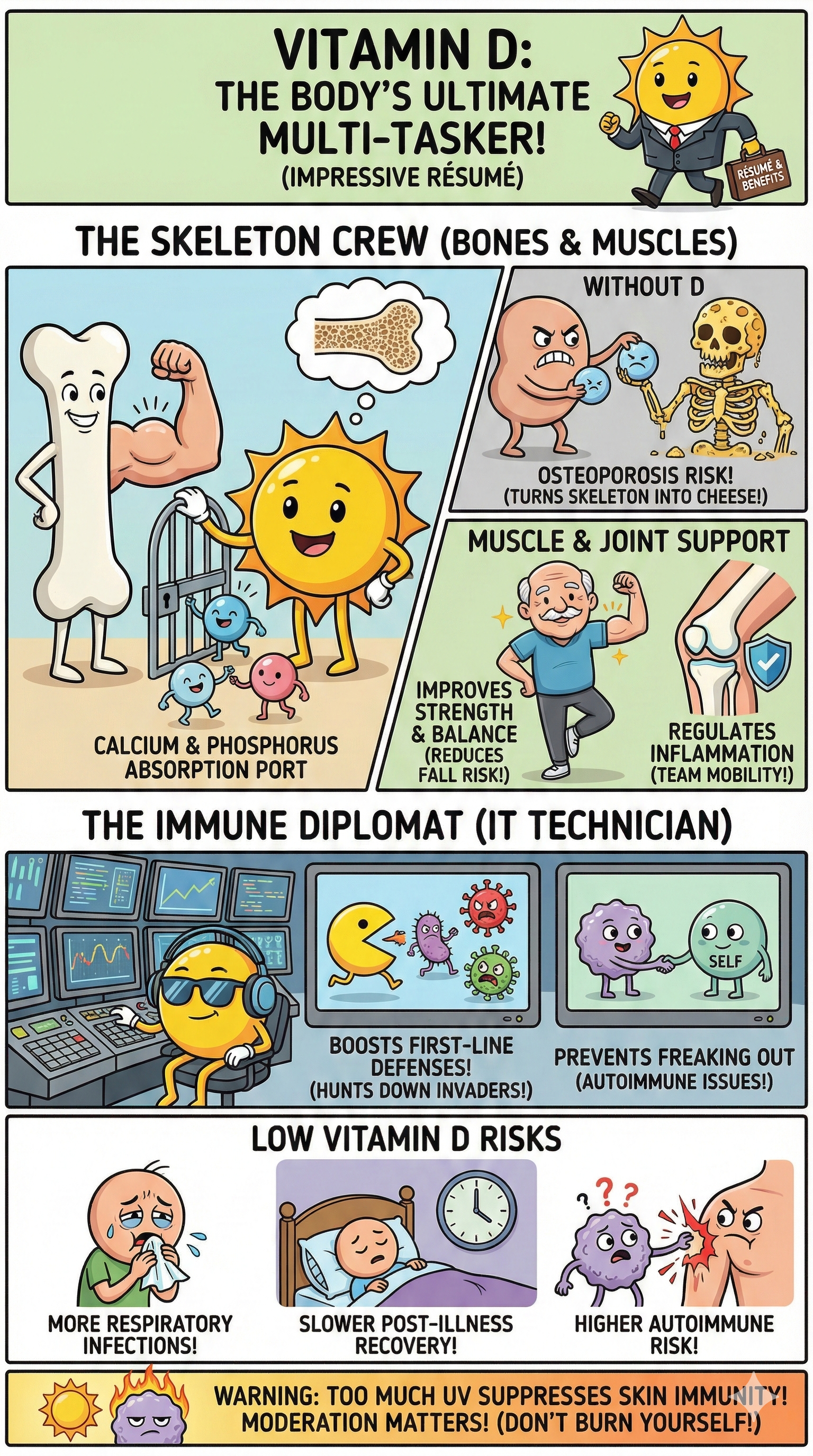
Vitamin D has a résumé so impressive it should really walk around with a briefcase. Let’s open the case and see what it actually does.
The Skeleton Crew (Bones & Muscles)
Without Vitamin D, your body cannot absorb calcium and phosphorus. Being resourceful (and rude), your body will simply steal the calcium from your own bones to keep your blood levels stable. This turns your skeleton into cheese (osteoporosis).
Muscles also have vitamin D receptors; adequate levels improve strength, balance, and reduce fall risk; big wins, especially as we age.
Joints get indirect support too because vitamin D helps regulate inflammation. It’s not a miracle cure, but it’s definitely on Team Mobility.
The Immune Diplomat
Vitamin D is like your immune system’s IT technician: it calibrates responses, boosts first-line defenses helping immune cells hunt down viruses and bacteria, and prevents the immune system from freaking out and attacking your own body (autoimmune issues).
Low vitamin D has been linked to:
- more respiratory infections,
- slower post-illness recovery,
- higher risk of autoimmune issues.
But too much UV flips the script by suppressing local skin immunity, so again – moderation matters; don’t burn yourself trying to boost your immune system.
The Cancer Paradox
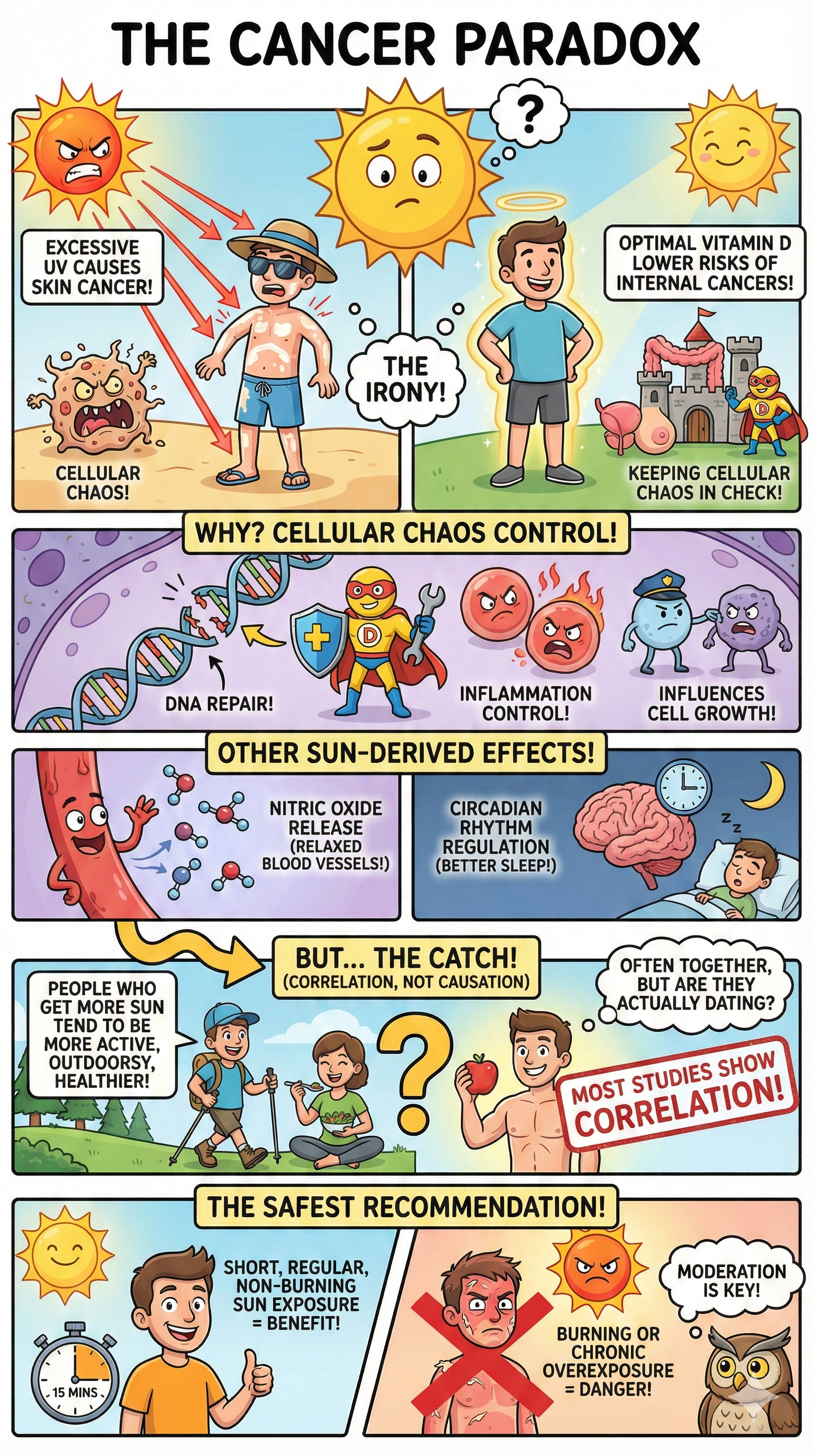
Here is the irony: Excessive UV increases skin cancer risk, but optimal Vitamin D levels (often achieved through moderate sun) are linked to lower risks of internal cancers like colon, breast, and prostate cancer.
Why? Likely because vitamin D influences cell growth, DNA repair, and inflammation control; essentially keeping cellular chaos in check.
Other sun-derived effects (like nitric oxide release and circadian rhythm regulation) may also help reduce chronic disease risks.
But there’s a catch: Most studies show correlation, not causation; in other words, they often show up together, but we don’t know if they’re actually dating. People who get more sun also tend to be more active, spend more time outdoors, and maintain healthier lifestyles overall.
Still, the safest, science-backed recommendation remains:
- Short, regular, non-burning sun exposure = benefit.
- Burning or chronic overexposure = danger.
END OF CHAPTER