A New Balanced, Science-Backed Guide to Tanning & Sun Exposure

This book was written to give a clear, science-based understanding of tanning and sun exposure, separating myth from measurable fact, so that you can enjoy sunshine intentionally, responsibly, and without becoming a dermatology slideshow.

A clear, science-backed guide to tanning and sun exposure separating myth from measurable fact, with practical advice and a touch of humor
CLICK / TAP on the book cover image to go to Chapter 1

There’s some lighthearted tone, friendly science talk, and occasional humor to keep things lively, but the science is legit. If any joke hits a nerve, please know none was meant to offend.

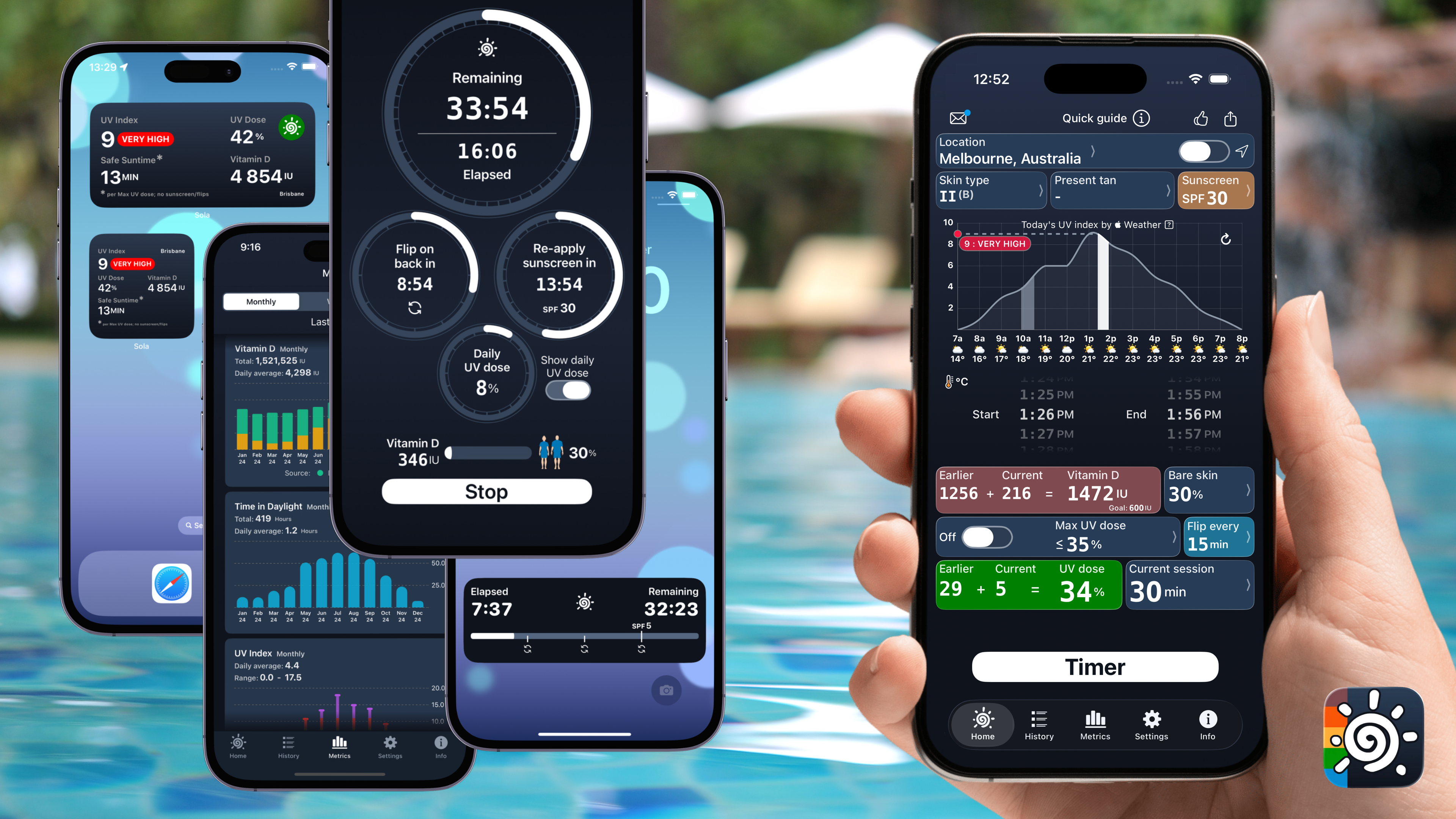
Proudly sponsored by Sola: UV Index and Sun Exposure, the sun-savvy iOS app that makes sun exposure management feel effortless.

Disclaimer

The human researched, checked, and re-checked the science but GenAI helped polish the wording and create illustrations (shoutout to ChatGPT and Nano Banana). There’s art for nearly every section, in case flipping through pictures is more your style.

Neither carbon-based nor silicon-based brains are perfect, so if you spot any errors, please write to:

support@getsola.com

Sola – Sun UV & Vitamin D Timer

Sunlight enhances your mood, relieves stress, improves sleep, and triggers vitamin D production. But too much sun exposure increases your chances of sunburns and skin cancer.

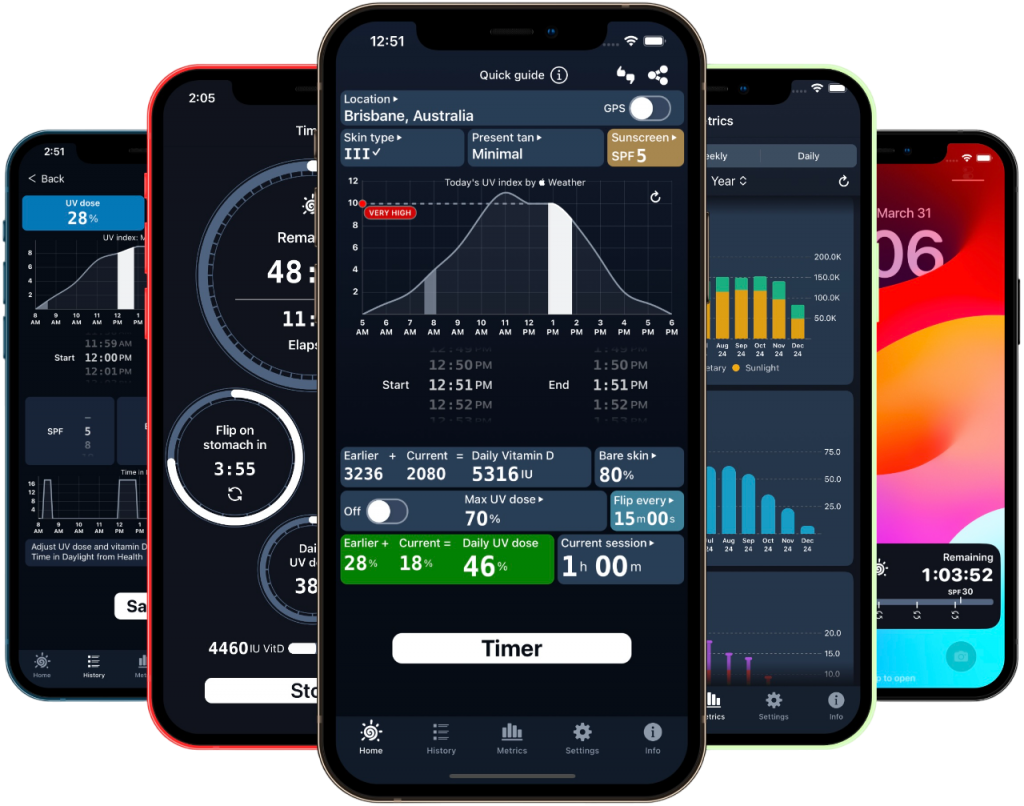
Sola calculates and tracks how much sun exposure you are getting based on current UV index forecast, your skin type, any existing tan, sunscreen SPF, and more.

Sola features a convenient Timer that reminds you when to re-apply sunscreen, when you need to get out of the sun, etc.

It also comes with an Apple Watch extension so that you can manage your UV exposure right on your wrist.

Sola optionally integrates with Apple Health app, specifically to read your Fitzpatrick Skin Type and to keep track of UV index that you were exposed to.

Also included now is Vitamin D tracking.

Lastly, thanks to its monochrome themes, you can actually interact with the app in bright sunlight, especially if you are wearing sunglasses.

Remember sun protection in autumn

In late summer and autumn, when the sky is cloudy, many people neglect to protect their skin from the sun’s rays – a widespread misconception that not only has unpleasant consequences, but also significantly increases the risk of skin diseases.

Clouds act like an invisible veil that seems to block out the sun. In reality, however, clouds allow up to 80 percent of UV rays to pass through. So-called “light” clouds are particularly dangerous, as they can reflect and even intensify sunlight. The deceptive thing about a cloudy sky is that you perceive the sun as less intense and therefore underestimate the risk of sunburn. The result: you stay outdoors longer without adequate protection – and your skin pays the price.

To minimize the risk of sunburn even on cloudy days, experts recommend always applying sunscreen with a high sun protection factor (SPF 30 or higher), especially if you are spending a long time outdoors. Sunscreen should be applied generously and reapplied regularly, especially after swimming or heavy sweating. Additional protective clothing such as sun hats, sunglasses, and light clothing are also advisable.

So anyone who thinks that sunscreen is unnecessary on a cloudy day should think again. Even in the shade or when the sky is slightly overcast, the danger is real and probably worse than you might think. The rule “better too much than too little” applies especially to sun protection. Your skin will thank you for it!

Be save with sunscreen and the Sola App

Clouds and Sun

Why the sun is more intense in the mountains

Altitude, cloud cover and the ozone layer also play a role: UV rays have a shorter path in the mountains and the air is thinner. This increases their intensity by around 10 percent per 1,000 meters of altitude.

When it is very cloudy, UV radiation is reduced by up to 90 percent. However, a thin cloud cover hardly keeps it out. On the contrary: certain cloud formations and fog can even increase it through scattering.

If the ozone layer is weakened – for example due to low ozone events in spring and early summer – an unusually high amount of UV-B rays reach the earth’s surface.

In addition, water, sand and snow intensify the radiation by reflecting it.

Shade, on the other hand, reduces UV exposure: under a sunshade, for example, by around 10 to 30 percent, under a large tree with a dense canopy by around 20 percent.

The lighter the skin, the less it can protect itself against sunlight and the more sensitive it reacts. Skin that contains a lot of melanin and is therefore darker is better protected, but skin damage cannot be ruled out here either.

Children and adolescents need special protection as they are much more sensitive to UV rays than adults.

Experts recommend that infants and small children under the age of two should not be exposed to the sun at all with uncovered skin.

UV radiation varies and UV protection clothing

Risk of UV radiation varies

Sunscreen, long clothing and shady places are important protection, especially in summer. According to the BFS-Germany, UV radiation can neither be seen nor felt. It is there even when the sun is not shining.

According to the data, the intensity and risk of UV radiation depends on many factors – such as the position of the sun, latitude, altitude above sea level, cloud cover and the ozone layer.

UV clothing: Not only useful for children

If you don’t protect yourself adequately from UV radiation, you risk sunburn, sunstroke or – in the worst case – skin cancer. Sun cream with a high sun protection factor is therefore essential.

How clothing with UV protection works

Special UV clothing and UV swimwear is made of tightly woven synthetic fibers such as polyester, nylon and spandex. “They are lightweight and breathable and block and absorb UV radiation,” explains Daniela Weiskopf, Head of the Optical Radiation Department at the Federal Office for Radiation Protection (BfS-Germany). In simplified terms:

Which UV clothing provides the best protection?

The BfS-Germany differentiates between the Australian-New Zealand Standard (AS/NZS 4399:1996), the European Standard (EN 13758-1) and the UV Standard 801 for the UV protection properties of UV clothing.

 Only the “UV Standard 801” seal proves that a garment still protects against sunlight even when wet, stretched and washed several times.

For whom UV clothing is particularly worthwhile

Textiles with the UV standard 801 are also recommended by the “International Testing Association for Applied UV Protection”. According to the Bremen consumer advice center, parasols, beach shells and awnings with a UV Standard 801 seal also offer the best protection.

UV protective clothing is particularly intended for people who spend many hours in the sun, for example

– because they work outdoors, for example on a building site,

– or do sport.

“But it is also suitable for people with very sensitive skin: children, but also teenagers and adults with very light skin tones.

UV protective clothing does not cover all parts of the body, which is why the BfS-Germany recommends applying plenty (LSF 30) of sun cream to uncovered parts of the body in good time.

“Four heaped tablespoons for the entire body of an average adult with a high to very high sun protection factor from SPF 30 are ideal,” says Daniela Weiskopf.

Sunglasses that filter UV radiation with wavelengths up to and including 400 nanometers should also be worn.

Sola got an ASO audit by ASO Ninja

Highly recommend the ASO Ninja team (https://asoninjapro.com). Their ASO audit was delivered quickly, with excellent attention to detail and actionable suggestions throughout. The team clearly understands both keyword strategy and user experience, and the recommendations were thoughtful, well-explained, and professionally presented. Great quality, fast turnaround, and a pleasure to work with.

Aloe Vera Gel

Aloe Vera for the skin

The gel from the thick leaves of the aloe vera plant is used for the skin.

Aloe vera gel moisturizes and has an anti-inflammatory effect. It is therefore particularly suitable for acne and eczema.

The leaf gel can be applied pure to the skin or extracted and mixed with other active ingredients to make an ointment.

The medicinal plant was already known as a household remedy in ancient times and was used by Cleopatra for skin care, as the plant contains numerous vitamins, minerals and essential oils. Due to its high concentration of vitamins A, C and E, aloe vera is often used to protect skin cells.

The B-group vitamins it also contains can increase cell metabolism fivefold. Aloe vera gel has a soothing and restorative effect, especially on sensitive skin.

Aloe vera against sunburn

1. if you have exposed your skin to the sun for a long time, you can use the aloe vera gel both preventively and as a remedy for skin burns.

2. the pure gel, either directly from the plant or from the pharmacy, helps quickly and reliably. It provides immediate cooling and thus relieves pain and itching.

3. it supplies the skin with valuable vitamins and minerals and thus contributes to regeneration.

4. it has an anti-inflammatory effect and thus prevents the burn from becoming too severe.

5. And the leaf gel provides the skin with moisture, which it desperately needs after too much sunbathing.

Aloe vera gel is the ideal home remedy for sunburn.

Ongoing issue with Apple Weather for some users

It seems there’s an ongoing issue affecting weather forecast retrieval for some users. An increasing number of developers have reported similar problems (cases: 789157789900789564, 789319, 786126, 788811 . I’ve already reported this to Apple and will share any updates here as they come. In the meantime, I’m working on a workaround. Apologies for the inconvenience to anyone affected.

UPDATE: Apple just reported that the issue should be resolved. Please reach out at support@getsola.com if you continue to see “clear-skies” UV forecast instead of from Apple Weather.

Health consequences of UV radiation

Sunny spring days entice us outdoors, but even in mild temperatures, UV radiation should not be underestimated.

Why sun cream and co are important now.

 People usually only think about sun protection when it gets really hot. But UV radiation is invisible and does not depend on the air temperature.

Even on cool days, there is a risk of damage to health.

The sun emits high-energy ultraviolet rays of various wavelengths: The UV-C component is completely absorbed by the ozone layer. In contrast, up to ten percent of UV-B radiation reaches the earth’s surface, while the UV-A component passes through the atmosphere almost unhindered.

Direct consequences

– Reddening of the skin up to sunburn, swelling, blistering, itching, pain

– Sun allergy with wheals and blisters

– Inflammation of the cornea or conjunctiva of the eye (e.g. snow blindness)

– Suppression of the immune system

– Formation of vitamin D (the only known positive biological effect of UV radiation)

Late effects

– Eye damage such as cataracts or uveal melanoma (eye tumor)

– Accelerated skin ageing

– skin cancer

The intensity of UV radiation depends on the time of year, time of day and latitude.

It is more intense in the summer months than in winter, and is most dangerous during the day at midday.

In addition, the radiation intensity increases the closer you get to the equator.

Without sun protection, the UV rays penetrate the skin and eyes and can cause damage.

The main cause of reddening of the skin is UV-B radiation, which mainly penetrates the epidermis, whereas UV-A radiation reaches the deeper layers of the skin.

UV index as a guide

The daily UV exposure and therefore the health risk at a location can be estimated using the UV index (UVI). It is published regularly by the German Weather Service and the Federal Office for Radiation Protection. The higher the index, the faster sunburn can occur on unprotected skin

 The scale was developed by the World Health Organization and is internationally standardized. A UVI of 5, for example, means the same in USA as in South Africa.

More and more spring sunshine

In spring, the sun gains strength from day to day, even if the heat is still moderate. Measurement data shows that UV index values that make sun protection necessary can be reached as early as March.

The German Weather Service is also registering more and more hours of sunshine in spring. On average, the sun now shines 87 hours longer across Germany than in the period from 1961 to 1990, which further increases the UV risk.

According to the President of the Federal Office for Radiation Protection, Inge Paulini, not everyone knows that you have to be careful even on sunny spring days. But “the awareness of many people that UV protection is important is growing”.

Water, sand and snow reduce radiation by reflecting it.

Shade, on the other hand, reduces UV exposure: under a parasol, for example, by around 10 to 30 percent, under a large tree with a dense canopy by around 20 percent.

The lighter the skin, the less it can protect itself against sunlight and the more sensitive it reacts. Skin that contains a lot of melanin and is therefore darker is better protected, but skin damage cannot be ruled out here either.

Children and adolescents need special protection as they are much more sensitive to UV rays than adults. Experts recommend that infants and small children under the age of two should not be exposed to the sun at all with uncovered skin.